CULTURAL MEMORY · PORTRAITURE · CONTEMPORARY RENAISSANCE
Who Gets to Inherit the Renaissance?
Cultural memory, historical authority and the contemporary reimagining of the classical portrait
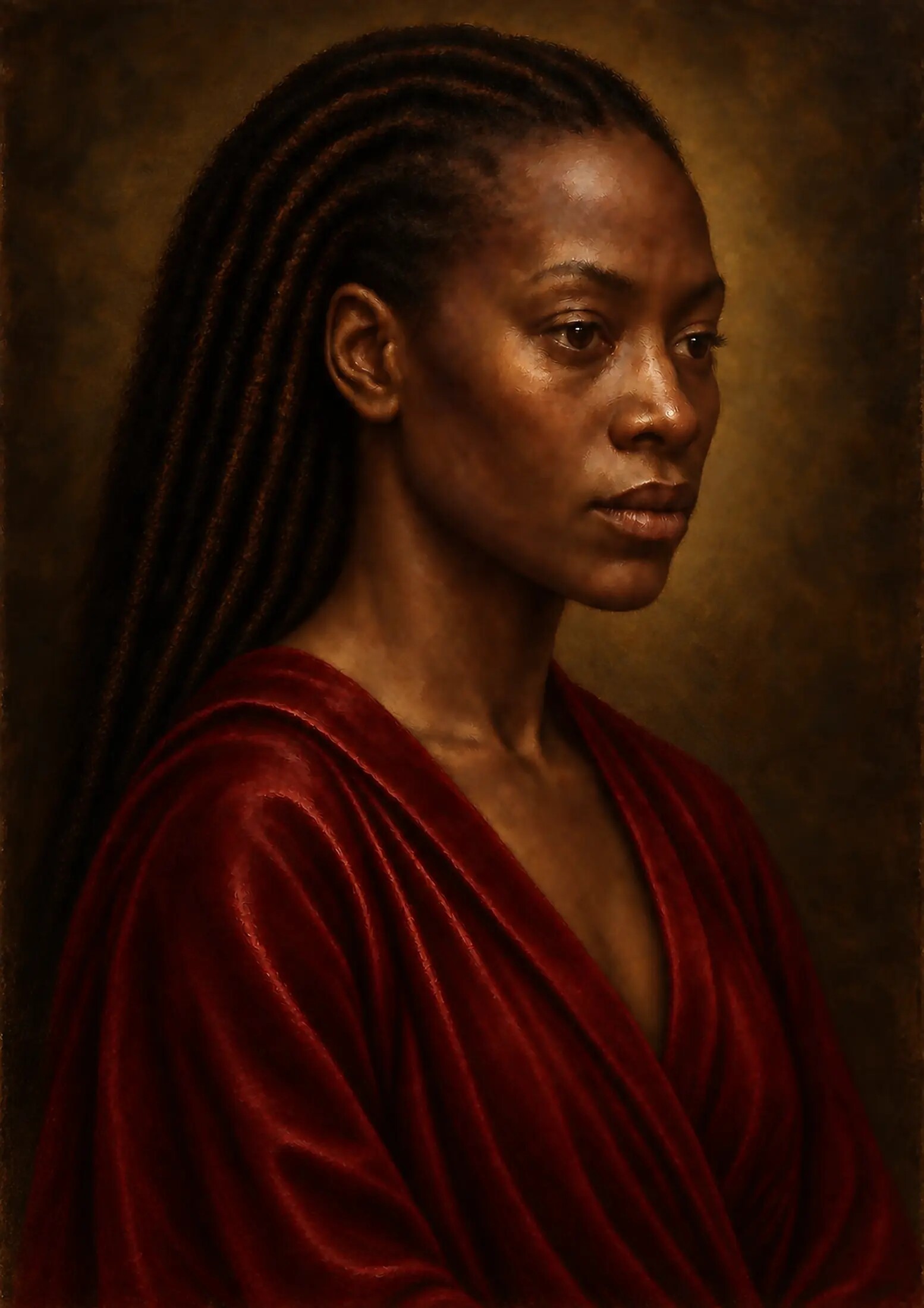
A Black woman stands within the visual atmosphere of Renaissance portraiture: composed, illuminated and entirely present. This essay asks what it means to inherit a tradition that has shaped ideas of beauty, power and artistic mastery while so often placing Black life at its margins.
There is a particular kind of authority that Renaissance portraiture knows how to construct.
It can begin with stillness. A figure occupies a carefully measured field. Light does not fall everywhere equally; it selects. The face emerges from darkness. Fabric holds weight. A small highlight on an eye, lip, jewel or fold becomes charged because the surrounding image has been disciplined enough to let it matter. Nothing appears hurried. The sitter is not passing through the frame. They have been given time, space and the expectation of being looked at.
That authority has never been purely technical.
Portraits do more than preserve appearances. They tell us whose presence was considered worthy of labour, material expense and public memory. Scale, pose, costume, setting and finish become arguments. A painting can announce rank without writing the word. It can make power feel natural. It can turn a private individual into a historical figure and allow that person to continue occupying a room centuries after their body has disappeared.
This is why the question behind my portrait is larger than whether a digital image can convincingly reproduce the visual behaviour of oil painting.
The technical question mattered. I wanted to know whether linen, ground, underdrawing, tonal modelling, dead colour, opaque paint, translucent glazing, broken scumbling, surface wear and varnish could be reconstructed within a digital studio. I wanted the image to contain the visual memory of a layered process rather than wear an oil-painting effect like a costume.
But another question gradually came into view:
Who gets to inherit the Renaissance?
Who is permitted to enter its visual language of gravity, beauty, contemplation and mastery? Who appears at the centre of the image, and who is pushed to its edge? Who is granted individuality, and who becomes an accessory, type or symbol? Who is remembered by name? And what happens when a contemporary Black figure occupies that space without asking permission from the history that once restricted it?
The Renaissance Was Never Only a Style
It is tempting to reduce the Renaissance to recognisable surfaces: dark backgrounds, dramatic light, rich fabric, composed faces, architectural proportion and the appearance of aged oil paint. These things form part of its visual language, but they do not explain its power.
The Renaissance was also a system for producing knowledge and authority. Art was entangled with religion, trade, dynastic ambition, scholarship, scientific observation, workshop labour and the display of wealth. Images travelled. Pigments travelled. Textiles, metals, ideas and people travelled. Patrons used painting to shape how they would be seen by those around them and by generations not yet born.
To inherit the Renaissance cannot therefore mean copying its surface while ignoring the world that surface helped to construct.
The classical portrait carries assumptions about importance. It has often been commissioned for rulers, aristocrats, merchants, clergy and other people whose position gave them access to an artist’s time and to costly materials. Even when the painting appears intimate, it may participate in a larger social performance. The sitter’s posture, clothing, surroundings and possessions communicate education, lineage, spirituality, authority or wealth.
Those conventions are not locked permanently to their original patrons. Visual language can be learned, challenged and transformed. But it should not be treated as innocent.
When a contemporary artist uses Renaissance composition, the result is not automatically progressive. A Black subject placed inside a historical style does not by itself repair the exclusions of art history. The image may simply repeat an inherited formula with a different face. The deeper work begins when the artist asks what the language has carried, whose interests it has served and how it might behave differently now.
For me, this means treating Renaissance technique as a form of visual intelligence rather than as a badge of borrowed prestige. I am interested in how its processes construct light, presence and material depth. I am equally interested in what happens when those processes meet African and diasporic knowledge, contemporary identity and emerging technology.
The work is not a return to the past. It is a negotiation with it.
Black Presence Was Not Absent
One of the most persistent distortions surrounding European Renaissance history is the idea that Black presence is an anachronism when it appears within it.
The surviving evidence tells a more complicated story.
Africans and people of African descent lived in Renaissance Europe. Their lives were shaped by sharply unequal conditions: some were enslaved; some were servants or attendants; others were artisans, musicians, sailors, merchants, diplomats, courtiers, religious figures or free residents. Their circumstances differed across cities, courts, legal systems and generations. No single category can contain them.
The exhibition Revealing the African Presence in Renaissance Europe, organised by the Walters Art Museum and later presented at Princeton University Art Museum, brought together a wide range of objects to examine Africans and their descendants in Europe from the late fifteenth to the early seventeenth century. Princeton described it as the first exhibition to assemble such a breadth of visual evidence around this subject. Its importance lies partly in refusing the assumption that African presence began only with later imperial or modern migration.
In England, John Blanke offers a rare case in which a Black individual can be connected to both a surviving image and documentary records. He worked as a royal trumpeter in the courts of Henry VII and Henry VIII. Payment records identify him by 1507; he appears twice on the Westminster Tournament Roll of 1511; he successfully petitioned for a wage increase; and the king gave him clothing for his wedding in 1512.
These traces do not give us a complete life, but they establish skill, employment, ambition and participation in court culture.
He was not outside Tudor history. He was helping to sound it into being.
The National Portrait Gallery describes the Tournament Roll image as the earliest known image of a named Black person living in Britain. That description contains both evidence and warning. John Blanke’s presence can be recovered because an image and administrative records survived together. Many other lives left different traces, were recorded under language that obscures identity, or were never preserved by institutions at all.
The problem, then, is not that Black people were absent from Renaissance Europe. The problem is that presence and remembrance are not the same thing.
Art history inherits what patrons commissioned, what collectors valued, what institutions acquired, what cataloguers named, what scholars studied and what later audiences were taught to notice. Survival is never a neutral sample of the past. The archive has a shape, and that shape reflects power.
To Be Visible Is Not Necessarily to Be Seen
Black figures appear in Renaissance and early modern European art in several recurring positions.
They may appear in religious subjects, especially as Balthasar in scenes of the Adoration of the Magi. They may appear as attendants, pages, musicians, servants or markers of geographic reach and material wealth. Sometimes they are rendered with close attention. Sometimes they are reduced to racialised types. Sometimes they are physically visible but biographically unavailable.
Jan Gossaert’s The Adoration of the Kings, painted around 1510–15, offers a richly worked Black Balthasar whose elaborate headdress carries one of the artist’s signatures. Gold, pearls, fabric and human particularity give the figure considerable visual force.
Yet Balthasar remains part of a Christian narrative in which identity is governed by an assigned religious role. The painting demonstrates presence, magnificence and extraordinary technique, but it does not provide access to an independently known sitter’s life.
This distinction matters. Visibility can still deny personhood.
A figure may be beautifully painted and remain unnamed. Their body may help establish the status of somebody else. Their difference may become part of the painting’s inventory of luxury, alongside velvet, armour, jewels, animals or imported objects. Their gaze may direct attention towards the principal sitter rather than meet the viewer. Their smaller scale or marginal placement may quietly communicate hierarchy.
None of these patterns should be simplified into a claim that every historic representation carries exactly the same meaning. Works differ. Contexts differ. Artists and patrons made particular choices. Religious figures, court employees, servants and enslaved people cannot be collapsed into one symbolic category simply because later viewers describe all of them as Black.
The words themselves require care.
Modern racial categories do not map cleanly onto every fifteenth- or sixteenth-century context. Historical records may use terms whose meanings shifted between language, location and period. To study Black presence responsibly is therefore to hold two truths together: modern viewers need language with which to recognise racialised representation, and that language must not erase the specificity of historical lives.
The most useful question is often not simply, ‘Is there a Black figure in this painting?’
It is: What work is the figure being made to do?
Are they allowed to possess an interior life? Are they central or peripheral? Are they named? Are they shown acting, looking, deciding or speaking? Does the composition recognise their presence, or use it to decorate another person’s power?
In 2020, the Uffizi Galleries made this problem of attention explicit through On Being Present, a virtual exhibition tracing Black identity and African presence within works in its collection.
The title is precisely judged.
Presence is both physical and interpretive. A figure can have occupied a painting for centuries and still remain unseen by the history built around it.
The Centre of the Picture Is Not an Innocent Place

The completed portrait at the centre of Painting Without Wet Paint shows a Black woman in profile, wearing a deep crimson velvet-like garment. Her braided hair forms a strong directional rhythm. Warm light finds the planes of her face and then recedes into a dark, chromatically varied atmosphere.
She is not presented as an accessory to another figure.
She is not reduced to ethnographic information. The painting does not crowd her with explanatory symbols in order to justify her presence. Nor does it require her to perform an easily consumed version of identity. Her authority is carried through composition, stillness, light and attention.
This matters because centrality is not only a matter of placing someone in the middle of a rectangle. A figure can be centrally positioned and still be denied control of the image. Visual authority depends on a network of decisions.
The scale of the head matters. The quantity of surrounding space matters. The direction of the gaze matters. So does the relationship between sharp and soft edges.
Light can honour a face, expose it, dramatise it or turn it into spectacle. Costume can convey self-possession or reduce a subject to display. Surface detail can produce intimacy, or it can become an intrusive inspection.
In this portrait, the face is allowed to emerge rather than being forced forward. The darkness does not erase the figure, but neither does it surrender all its information immediately. The eyes and mouth receive particular attention without becoming isolated demonstrations of technical virtuosity. The crimson garment carries richness and weight while remaining subordinate to the psychological presence of the sitter.
The figure’s profile also complicates the conventional exchange between portrait and viewer. She does not offer complete access. Her gaze travels beyond the frame. We encounter her, but we are not given ownership of her attention.
That withholding is important.
Portraiture has often trained viewers to believe that looking is an uncomplicated right. Museums intensify this habit: objects are illuminated and made available for prolonged examination. But the represented person is not merely there for consumption.
A portrait can create an encounter while preserving distance. It can make presence available without making the subject entirely possessable.
The woman’s turned gaze establishes precisely that tension. She is visible, but she is not presented as waiting for the viewer’s approval.
Dignity Is Constructed Through Time

The long, layered process used to create the portrait is inseparable from its cultural meaning.
Renaissance-inspired authority cannot be reduced to a dramatic-light preset. It emerges through the sense that the image has received sustained attention.
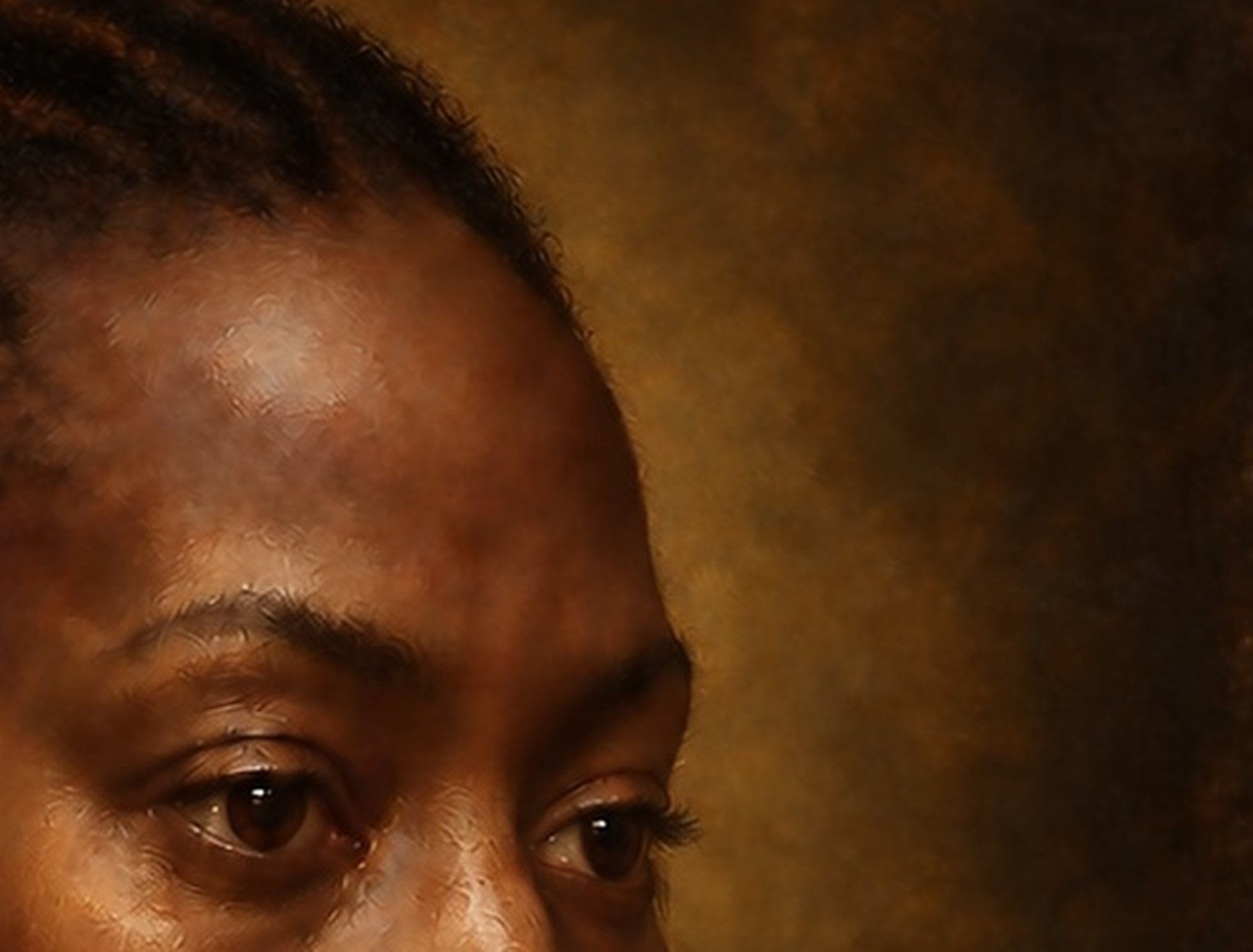
The simulated linen and prepared ground establish an imagined material beginning. The underdrawing gives the figure structural integrity. The tonal underpainting makes light accountable to anatomy. Restrained dead colour prevents the image from spending all its intensity at once. Glazes deepen the crimson and the skin without covering the modelling beneath. Scumbling returns broken light to the surface. Macro inspection removes details that look impressive but fail physically or anatomically.
These stages create visual depth, but they also create duration.
That duration matters in an image of a Black woman because histories of representation have often operated through speed. A type can be produced quickly. A stereotype needs only a few repeated signals. Individuality requires more patient looking.
I do not mean that technical complexity automatically produces ethical representation. A highly finished painting can still objectify its subject. Nor does labour alone prove artistic seriousness.
The question is what the labour serves.
Here, the process was used to protect particularity. Skin could not become a single sampled brown. It needed warm and cool transitions shaped by bone, circulation, atmosphere and reflected colour. Braids could not become decorative lines pasted around a head. They needed mass, direction, shadow and selective light.
The eye could not be reduced to a bright highlight. It needed lids, moisture, depth and an illumination consistent with the whole face.
Close inspection became a form of responsibility. Each passage had to remain connected to the person and material it described.
The result is not dignity because the subject has been dressed in the visual clothing of Europe. Dignity does not originate in Renaissance convention, and it is not granted by it.
Rather, the historical language is being redirected. Its patience, compositional gravity and material intelligence are placed in service of a presence that does not depend upon the old hierarchy for its value.
Inheritance Is Not the Same as Imitation
There is a difference between inheriting a tradition and attempting to disappear inside it.
Imitation tries to reproduce a recognised appearance. Inheritance involves selection, argument and change. It accepts that a tradition can offer knowledge while also carrying exclusions. It asks what should be learned, what should be refused and what can be made to serve a new purpose.
My relationship with Renaissance and early Flemish painting operates in this way.
I am interested in their understanding of layered light, tonal structure, drawing, edge control and differentiated surfaces. I am interested in the slow accumulation of authority: the way a face can become present through relationships between opacity and transparency, softness and precision, concealment and revelation.
I am not attempting to manufacture a counterfeit historical object. The work does not claim that oil pigment was physically applied to linen. It does not pretend to have survived five hundred years. Its ageing is restrained because false damage would create a history the object has not lived.
The painting belongs to the digital present.
Its relationship with history is methodological, visual and cultural. Artificial intelligence participated in the production and reconstruction of visual material. Digital tools allowed repeated close inspection, non-destructive comparison and highly local correction. The final work is intended to move into physical life through fine-art printing rather than through a false claim of material identity.
This openness about medium is part of the inheritance.
The Renaissance was not created by artists who refused technical change. Its workshops were places where optics, anatomy, geometry, chemistry, craft knowledge and new forms of reproduction met.
To inherit that curiosity is not to repeat the exact tools of the fifteenth century. It is to bring the same seriousness to the tools of one’s own time.
The Danger of Borrowed Grandeur
Classical portraiture offers a powerful visual shortcut. Place a contemporary sitter in a heroic pose, surround them with ornate fabric or architecture, and the image can immediately appear to speak about power.
But grandeur can become empty.
If the historical reference does all the work, the contemporary subject may remain trapped inside someone else’s costume. The image announces importance without discovering what kind of importance it means. It may reverse a racial hierarchy at the level of casting while leaving every deeper assumption about power intact.
This is one reason the question of inheritance cannot end with inclusion.
Contemporary Black portraiture has developed many different relationships with European art history.
Kehinde Wiley’s portraits, for example, deliberately recast people encountered in contemporary life within poses and formats associated with Old Master and grand-manner painting. The Brooklyn Museum described his portraits as works that engage specific historical paintings while replacing their European aristocratic subjects with everyday men and women.
The change is immediately legible because the older convention remains visible inside the new work.
That approach has become influential because it exposes the relationship between pose and power. It shows how quickly viewers recognise the codes through which art has elevated certain bodies.
My own interest is related but not identical.
I am less concerned with replacing one named historical sitter or recreating one famous painting. I am interested in rebuilding the underlying visual grammar: the prepared ground, the disciplined drawing, the tonal architecture, the layered colour, the material differentiation and the controlled emergence of presence.
This shift matters. The historical language should not sit around the subject like borrowed clothing. It should be transformed by the person, cultural memory and contemporary process entering it.
The question is not: ‘Can this Black figure look like an Old Master portrait?’
The more demanding question is: ‘What becomes possible when the intelligence of historical painting is placed inside a different cultural and technological world?’
African and Diasporic Knowledge Is Not an Added Theme
There is a tendency within cultural institutions to treat African and diasporic meaning as additional content: something applied to an otherwise complete European framework.
That arrangement leaves the hierarchy intact.
Europe supplies the form; Africa supplies the theme. The classical tradition remains universal, while Black experience is presented as a specialist subject introduced later.
My practice resists that division.
African and diasporic knowledge does not enter the work as decoration applied after the composition has been solved. It affects the question of who is represented, how memory travels, which symbols are activated, how identity relates to ancestry and how a viewer is invited to encounter the work.
It changes what the historical technique is being asked to carry.
This does not require every artwork to explain its cultural references exhaustively. In fact, explanation can become another form of control when a work made from diasporic experience is expected to translate every part of itself for an imagined outsider.
Some knowledge can remain layered.
A symbol may operate spiritually, historically and compositionally at the same time. A material may refer simultaneously to trade, ritual, geology, luxury and light. Braided hair can be understood as form, cultural practice, identity, inheritance and contemporary presence without being reduced to any single one of those meanings.
The Renaissance framework is therefore not the container into which cultural memory is placed. Both are active. They meet, test and alter one another.
That is why I describe the work as part of a contemporary Renaissance rather than a Renaissance revival.
Revival can suggest the return of something complete. Contemporary Renaissance suggests another opening: a period of enquiry shaped by histories and people who were never outside modernity, even when dominant accounts placed them there.
The Technology Introduces Another History of Power
The use of AI makes the question of inheritance more complicated.
Generative systems are trained on vast collections of existing images and descriptions. Those collections carry the unequal history of visual culture: what was photographed, digitised, catalogued, circulated and repeatedly named.
The machine does not approach the Renaissance—or Black identity—from an empty position. It inherits patterns from the archive.
That inheritance can become visible through error.
A system may produce a generic version of Black beauty. It may confuse cultural specificity. It may exaggerate exoticism, smooth away individuality or treat European costume as the primary signal of historical importance. It may imitate the most obvious surface conventions while failing to understand the structure beneath them.
This is why AI cannot be treated as an independent historical imagination.
In the studio process, its proposals had to be judged continuously. Anatomy could drift. Skin could become plastic. Braids could lose their physical construction. Reflections could contradict the established light. Fabric could look luxurious in isolation but belong to a different optical world from the face.
A technically impressive passage could weaken the cultural and emotional coherence of the portrait.
The response was not simply to request more detail. It was to establish stronger artistic laws.
The subject’s identity had to remain coherent. Light had to belong to one environment. Materials had to respond differently according to their physical character. Historical references had to inform the work without swallowing its contemporary life. Generated passages had to be accepted, corrected or rejected according to the painting’s needs.
Authorship resides in that continuity of responsibility.
The machine expands the field of visual possibility. It does not decide what the image owes its subject, its history or its viewers.
Those decisions remain human.
A Portrait Can Be a Meeting Place
The artwork does not attempt to solve the history of representation. No single portrait could.
What it can do is create a meeting place.
Within the image, Renaissance compositional discipline meets a contemporary Black presence. Historical methods meet a digital and AI-assisted studio. Simulated linen and pigment behaviour meet the future material reality of ink, paper, framing and exhibition light.
European painting knowledge meets African and diasporic cultural memory without either being reduced to a decorative quotation.
The meeting is not perfectly comfortable. Nor should it be.
The Renaissance offers extraordinary artistic knowledge, but it also sits inside histories of patronage, hierarchy, trade, religious authority and expanding European power.
Digital technology offers extraordinary control, but it carries questions about training data, labour, bias, ownership and the acceleration of image production.
Fine-art printing gives the image a physical body, but it also raises questions about edition, value, access and the relationship between surface illusion and material truth.
The artwork gains meaning by holding these tensions rather than pretending they have disappeared.
Its beauty is not an escape from cultural history.
Beauty becomes one of the ways that history is entered.
Beyond Permission
To ask who gets to inherit the Renaissance may sound as though some authority still holds the keys.
That is not where I want the question to end.
Cultural inheritance is not awarded only by the institutions that have historically defined the canon. Artists inherit through study, proximity, resistance, reinterpretation and use. They inherit techniques, questions, unresolved histories and possibilities.
They may inherit from traditions that excluded them because exclusion does not create permanent ownership.
At the same time, inheritance carries responsibility.
It asks for more than visual quotation. It requires serious research. It requires attention to the people present in the historical record and to those whose names have been lost. It requires precision about what a medium is and is not.
It requires an artist to distinguish reverence for craft from obedience to hierarchy.
The aim is not to place a Black woman inside an unchanged Renaissance and declare the work complete.
The aim is to allow her presence to change the territory.
She brings another history into the light. Her image changes what the composition remembers. The braids, skin, profile and controlled gaze do not merely occupy an inherited format; they place pressure upon it.
The historical language must make room for a subject who is not there to authenticate somebody else’s power.
She does not stand at the edge of the painting.
She does not look towards a principal figure located elsewhere.
She is the event around which the light has been organised.
A Contemporary Renaissance
The most valuable aspect of the Renaissance is not the fantasy of returning to a period of unquestioned mastery. It is the idea that art can be a serious form of investigation.
Painting brought together observation, geometry, material experiment, symbolism, anatomy, optics and imagination. The studio was not merely a place where images were decorated. It was a place where knowledge was tested through making.
A contemporary Renaissance practice can recover that ambition without reproducing the exclusions of the historical period.
It can study Old Master methods while questioning the canon that preserved them. It can bring African and diasporic knowledge into the structure of the work rather than attaching it as explanation. It can use AI without surrendering artistic control.
It can move from digital construction to museum-quality physical presentation while remaining honest about the distinction between simulated paint and actual pigment.
Most importantly, it can ask different people to occupy the visual space of contemplation, mystery, beauty and authority.
The finished portrait does not claim to be an undiscovered object from the sixteenth century. Its purpose is not to deceive the viewer into believing that history was different from what it was.
It does something more active.
It acknowledges the history, learns from its craft and refuses its boundaries.
The woman in the painting does not need the Renaissance to give her dignity. But by placing her within a visual language that has helped define who appears timeless, the work exposes that language to change.
Perhaps that is what genuine inheritance looks like.
Not the preservation of a tradition in perfect isolation.
Not the replacement of one face while every old hierarchy remains untouched.
But a living encounter in which technique, memory, identity and invention alter one another—and in which the image that enters the future is no longer governed by the limits of the past.
RELATED STUDIO STUDY
Painting Without Wet Paint
The illustrated case study follows the portrait through prepared linen, underdrawing, tonal underpainting, dead colour, glazing, scumbling, close inspection and preparation for physical fine-art printing.
Follow the complete process →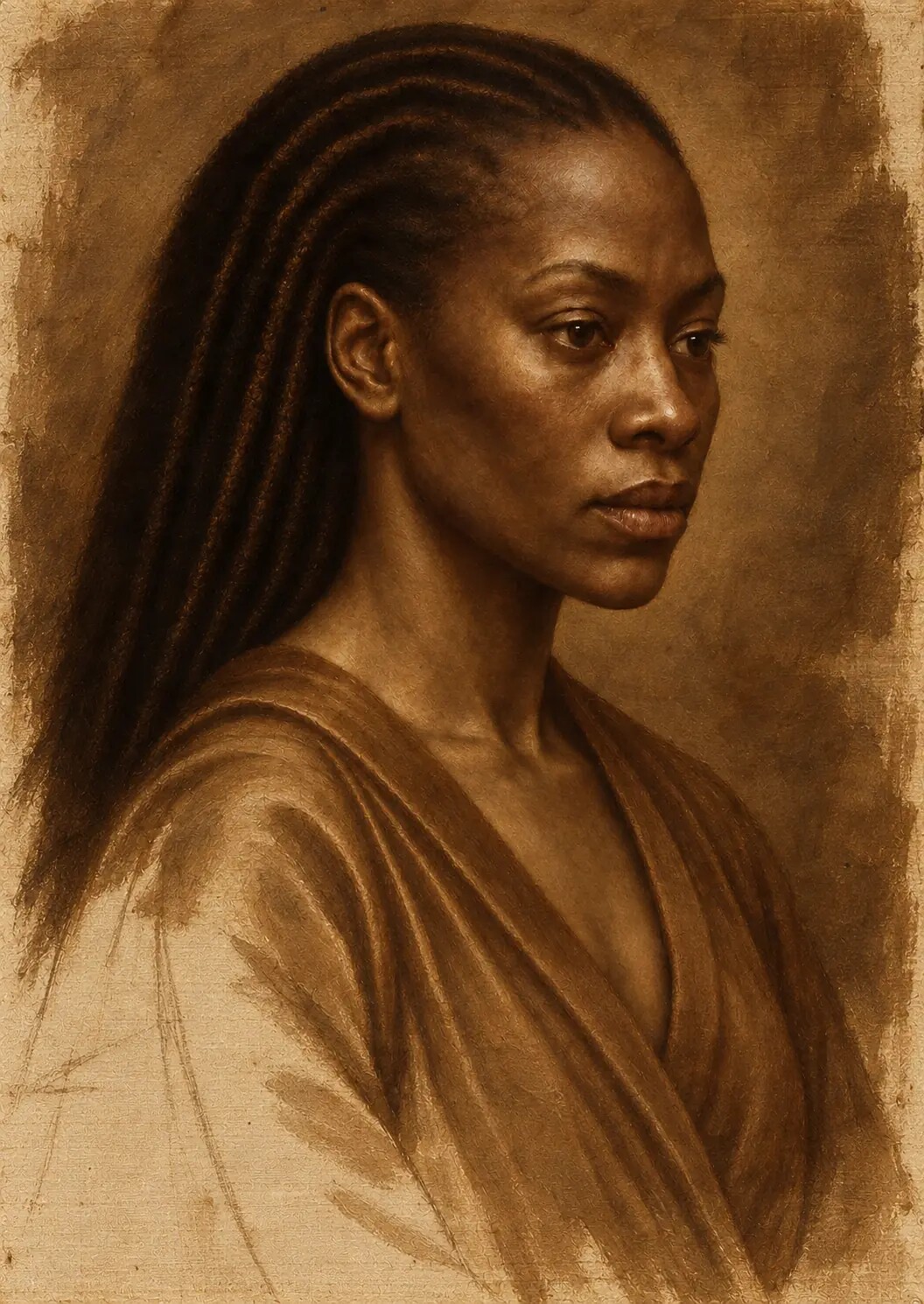
ARTWORK AND PROCESS STATEMENT
Method, medium and authorship
The portrait discussed in this essay is a digital and AI-assisted artwork directed and approved by Jabbi Delahaye.
Its construction simulates selected visual behaviours associated with Renaissance and early oil-painting processes. It does not claim that physical oil pigment was applied to linen during the creation of the digital master.
The work is intended for translation into a physical fine-art print through a separately controlled proofing and production process.
SOURCES AND FURTHER READING
Continue the enquiry
- Historic Royal PalacesJohn Blanke—A Black Musician at the Tudor Court↗
- National Portrait GalleryJohn Blanke on the Westminster Tournament Roll↗
- The Metropolitan Museum of ArtThe Black Presence in Tudor England↗
- National GalleryJan Gossaert, The Adoration of the Kings, 1510–15↗
- Uffizi GalleriesOn Being Present: Recovering Blackness in the Uffizi Galleries↗
- Walters Art Museum and Princeton University Art MuseumRevealing the African Presence in Renaissance Europe↗
- Brooklyn MuseumKehinde Wiley—A New Republic↗