OBJECT · MEMORY · FICTIONAL HISTORY
The Vase That Remembered the Garden
Making an Object, a Memory and a History That Never Existed
A CONSTRUCTED MUSEUM ENCOUNTER · JABBI DELAHAYE
01 · ENCOUNTER
Begin with the object, before its explanation.
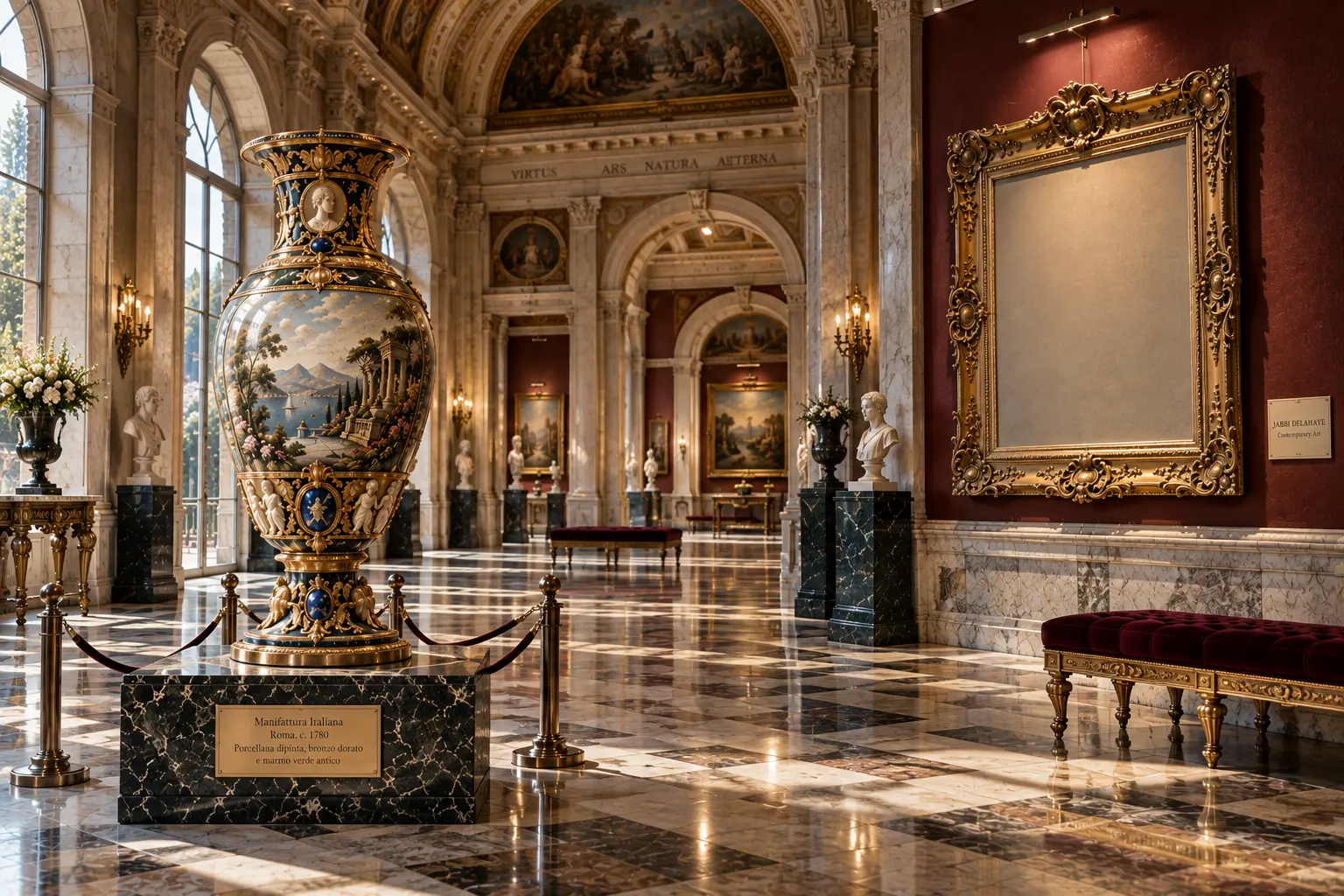
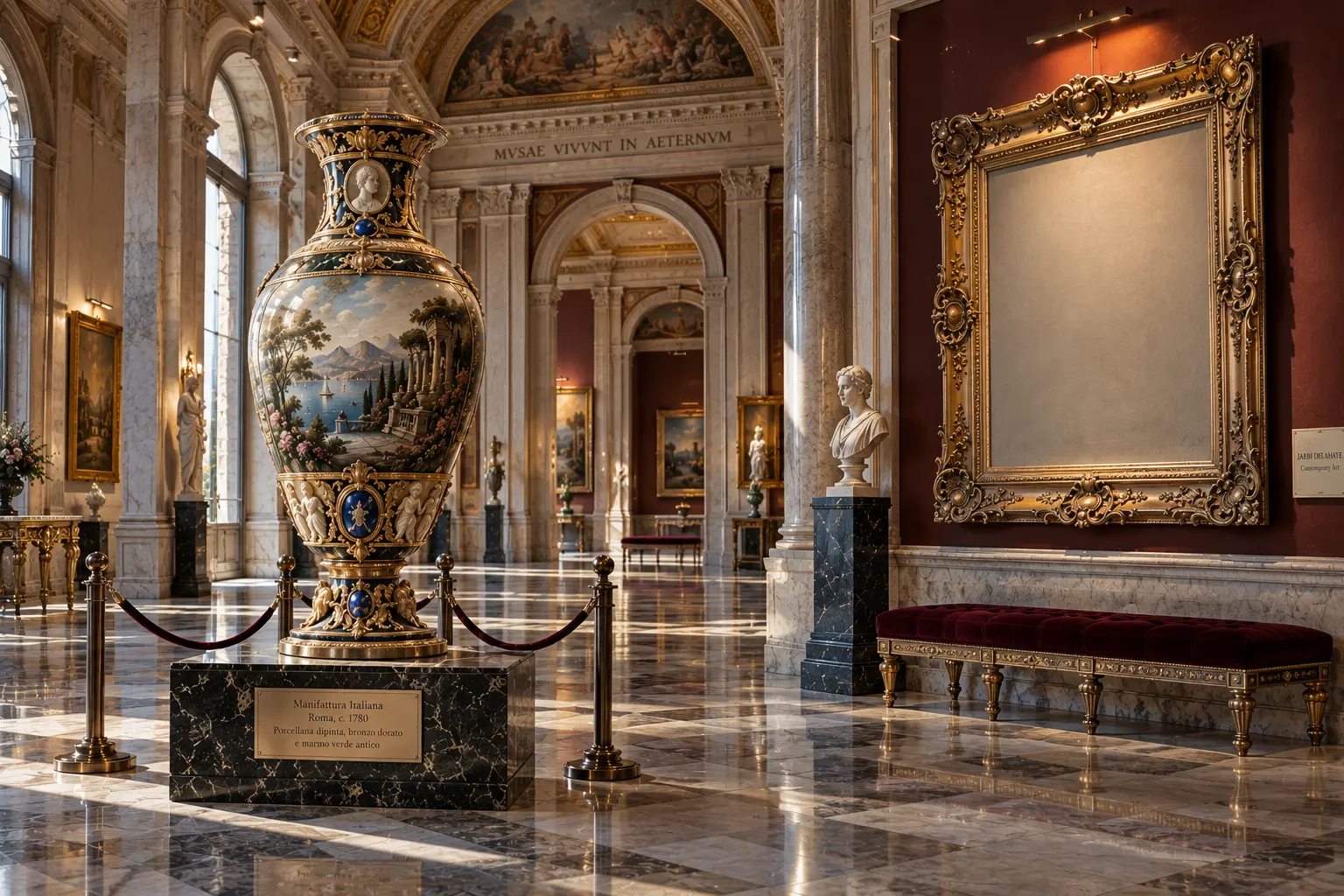
A monumental vase stands inside a museum-like gallery. Its painted surface appears to contain a complete world: terraces, cypress trees, pale architecture and a lake opening towards distant mountains.
The work begins with belief. Scale, light, marble, rope barriers and a small museum label lend authority to something that has no material past. The setting asks the viewer to look first and verify later.
02 · LEARNING THE OBJECT
Studying the grammar of an Italian vase
Before inventing the object, I learned its visual language: the proportion between foot, body, shoulder, neck and rim; the way gilded ornament follows curvature; the relationship between painted scene and ceramic volume; the restraint required for a handleless silhouette to remain elegant.
The aim was not to copy a surviving vase. It was to understand enough historical logic to construct a convincing relative—an object that could appear familiar without ever having existed.
03 · CREATING THE VASE
Construction through direction, refusal and revision
Silhouette
The form was simplified into a refined, handleless profile so the object felt architectural rather than ornamental for ornament’s sake.
Surface
Decoration was treated as a system of borders, reserves and transitions that must follow the imagined ceramic body.
Image
The garden scene was integrated as memory held by the vessel, not as a flat picture applied after the fact.
Presence
Lighting, patina, scale and display were tuned until the vase could sustain the psychological weight of an heirloom.
04 · ELISABETTA’S GARDEN
A place remembered more clearly than it ever existed
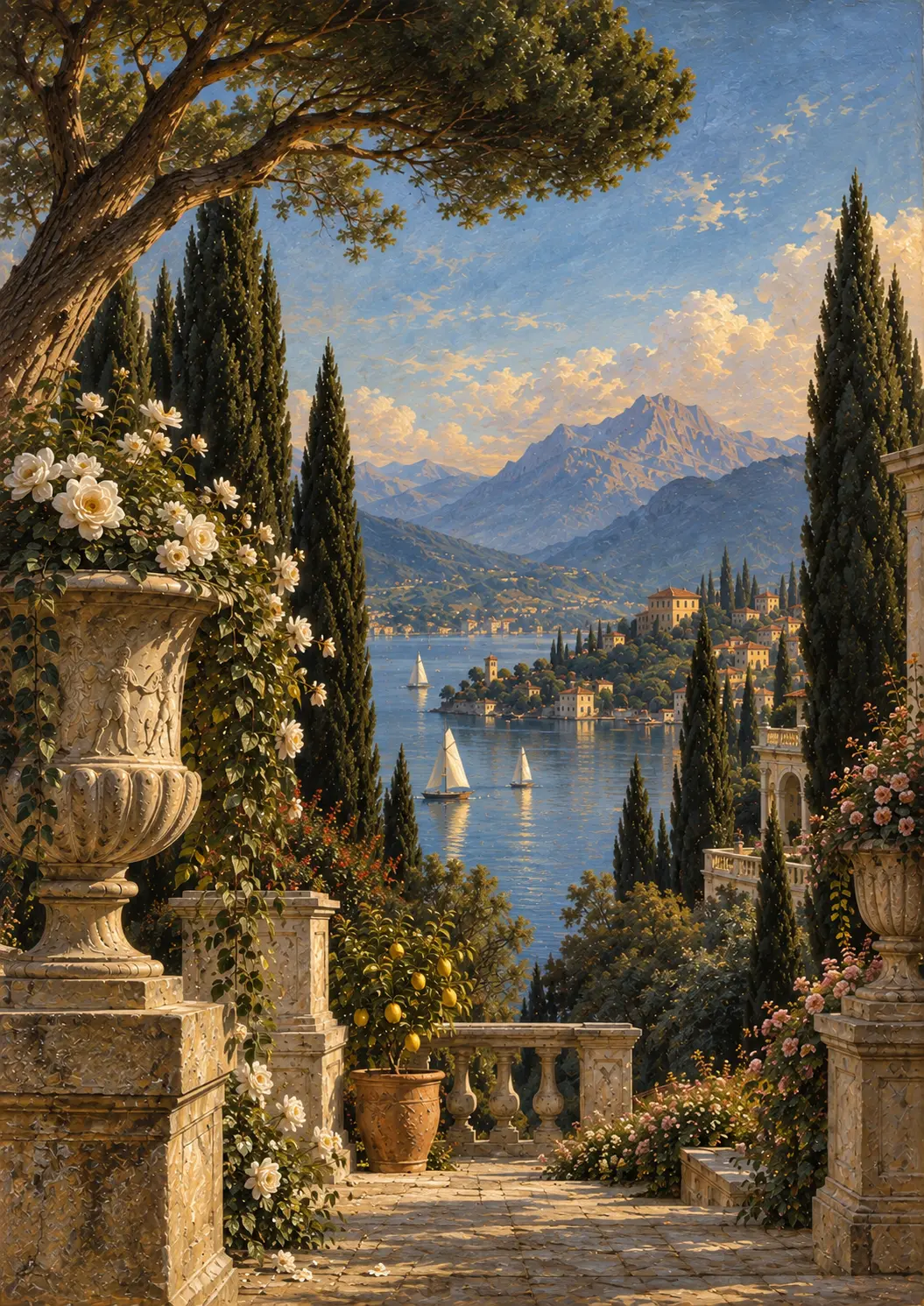
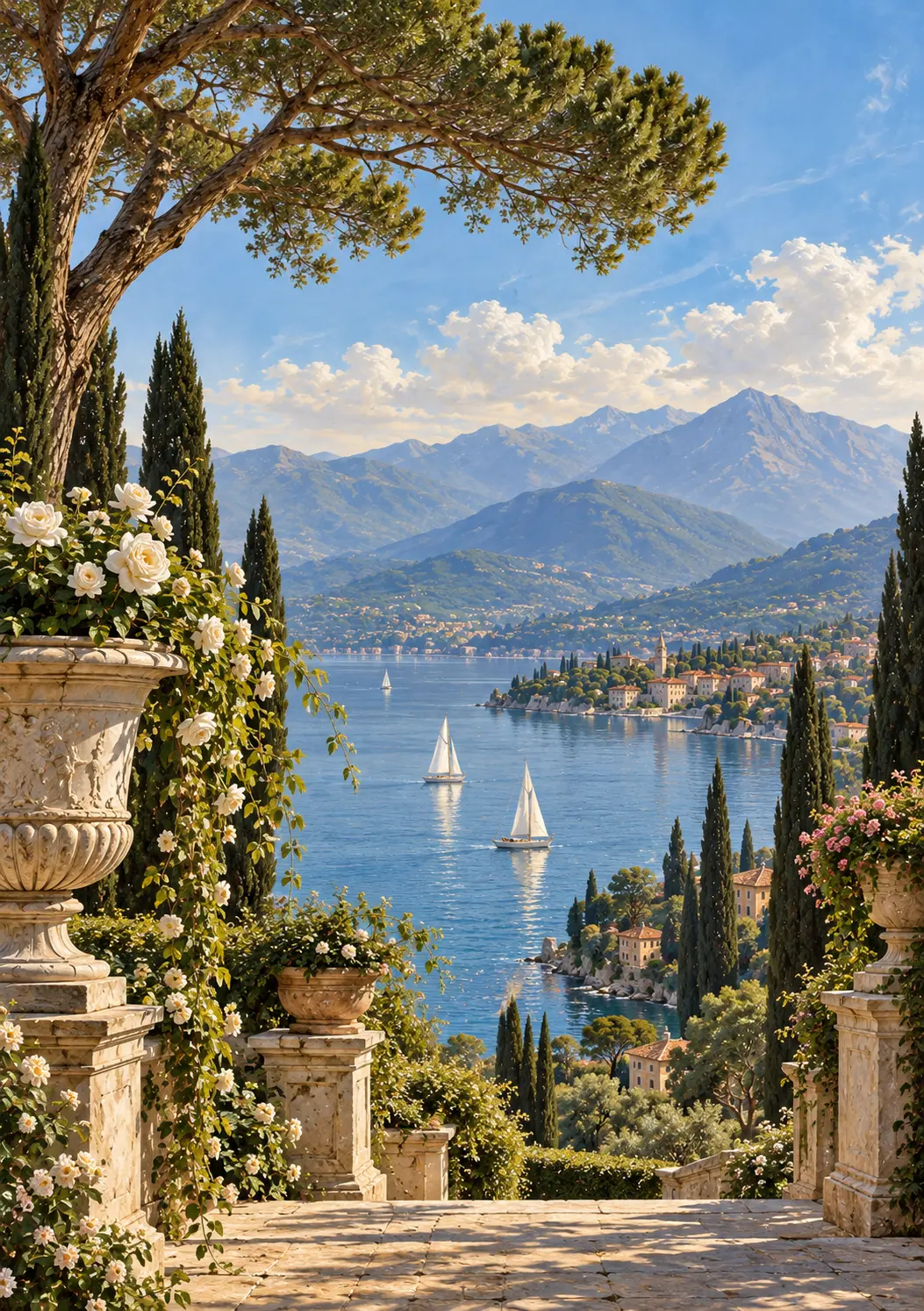
The garden belongs to Marchesa Elisabetta Valdieri, a fictional figure created for the work. It is not one documented site but a condensation of central Italian and northern lakeside visual memory: stone terraces, clipped cypress, white roses, distant villas, blue water and mountain air.
“The vase contains the memory. The painting allows us to enter it.”
05 · FICTIONAL PROVENANCE
The life of Il Vaso del Giardino
This chronology is deliberately invented. Its museum language is part of the artwork, showing how dates, names, ownership and gaps can manufacture confidence around an object.
- 1802
Rome
Commissioned, in the imagined history, by Marchese Alessandro Valdieri for Marchesa Elisabetta Valdieri at Palazzo Valdieri.
- c. 1810
Palazzo Valdieri
Known within the household as Il Vaso del Giardino—the vase of the garden—after Elisabetta’s remembered lakeside landscape.
- 1848
Italy
The Valdieri collection is dispersed during political upheaval; the vase leaves the palace and its paper history fragments.
- 1875
England
Recorded in the fictional Bellamy collection, where the object is separated from the story of the woman whose memory it holds.
- 1939
Untraced
The vase disappears from view. Its absence becomes part of the work: an empty interval open to speculation.
- 2019
Rediscovery
Re-emerging with signs of damage and repair, it is conserved and presented as though entering a museum collection.
06 · LANDSCAPE ESCAPES THE VASE
The contained image asks for its own space.
Once the landscape was established on the curved body, it no longer felt secondary. The painted reserve became a threshold. I began to imagine what lay beyond its border—what the vase could not show, and what memory might add.
07 · OIL PAINTING
Translating an invented memory into painterly depth
The independent garden image was developed through a digitally constructed, AI-assisted studio process under sustained artistic direction. Light, recession, foliage, architecture and surface were revised to evoke the optical atmosphere of a layered oil painting without claiming that wet oil paint was used.
The image is being considered for an A3 fine-art presentation. Paper, colour response, scale and framing remain subject to physical proofing before any edition specification is final.
08 · TWO IMAGES, ONE MEMORY
Object and landscape become evidence for one another.
09 · MUSEUM
Display is not neutral.
The gallery completes the fiction. Architecture, distance, labels and controlled access make the object feel protected, authenticated and already interpreted. The museum is therefore not a background; it is one of the materials from which the work is made.
10 · REVELATION
None of this history happened.
The Valdieri family, Palazzo Valdieri, the Bellamy collection, the disappearance and rediscovery are fictional. The vase and garden are contemporary constructed images. Their provenance is written as part of the artwork—not as a claim about an antique object.
This disclosure does not collapse the work. It reveals its actual subject: how visual authority is assembled, how memory becomes material, and how readily a convincing object can acquire a past through the structures surrounding it.
11 · CREATING A REALITY
A fiction can be honest about being made—and still become emotionally real.
“The vase contains the memory. The painting allows us to enter it.”
The work does not restore a lost object. It creates the conditions in which loss, inheritance and remembrance can be felt. What never existed begins to carry consequence because image, object, text and setting agree to hold the same imagined world.
Return to Inside the Work →