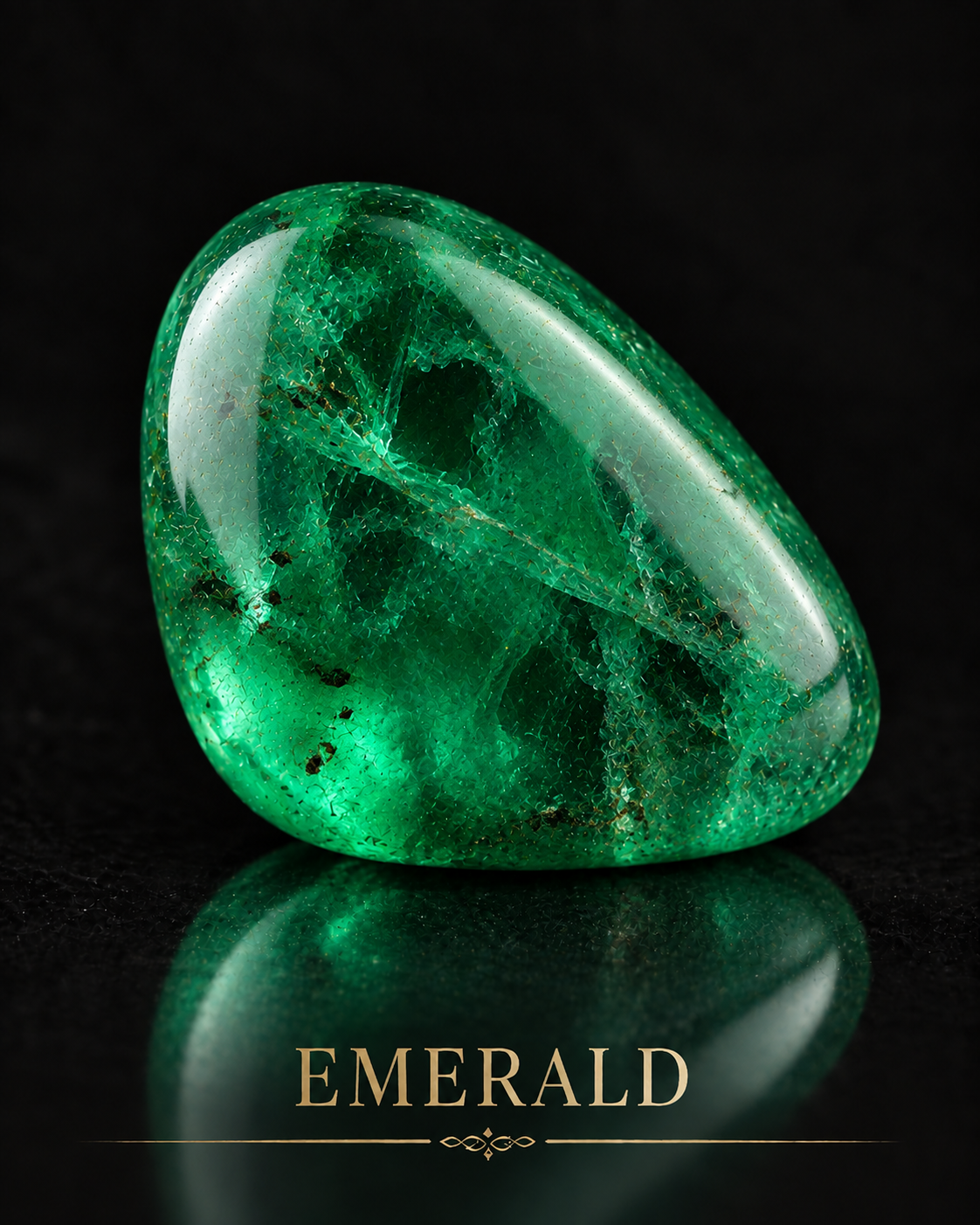
Emerald draws the eye into green rather than simply covering a surface with it. In this visual study, a rounded polished form emerges from black, its illuminated edges enclosing a complicated interior. Pale reflections travel across the outside while darker marks interrupt the colour beneath. The impression is of a small landscape held inside a stone.
That landscape offers a starting point for art: growth, enclosure, vulnerability and the persistence of something living. Those are proposed readings of the image. Emerald’s documented history brings other concerns into view, including extraction, long journeys, royal display and the ways a jewel acquires new meanings when it changes hands.
Green with an interior
Emerald belongs to the beryl family. GIA identifies chromium, vanadium and iron as trace elements affecting its colour; their relative presence helps determine the particular green. Emeralds commonly contain inclusions visible without magnification. Their mossy or garden-like appearance is often described in the trade as jardin, the French word for garden.
This is a useful vocabulary for looking closely. A transparent gem need not present an empty interior. Lines, interruptions and changes in light can make its depth perceptible. GIA also explains that inclusions can reduce transparency and that appearance overlaps between geographic sources. Colour alone therefore offers no dependable passport for a stone.
For an artist, the garden metaphor can become a method of composition. A small dark passage can create distance; a pale thread can suggest a path. Keep the pattern uneven enough to invite examination. A perfectly repeated network would feel decorative, whereas differences of density allow the viewer to imagine an interior that continues beyond what can be seen.
The generated image above explores that possibility through a polished, rounded form. It is a visual interpretation, not an authenticated specimen. Its colour and internal textures cannot establish a mine, treatment history or gemological identity.
Ancient Egypt: a long attachment to green
GIA’s historical overview places the earliest known Egyptian emerald mines at least as far back as 330 BCE and describes their use into the eighteenth century. It also records Cleopatra’s attachment to emerald and its place in her royal adornment. The connection belongs to Egypt’s long history of precious materials, including the Ptolemaic period in which Cleopatra lived.
The same overview describes traditions that associated emerald with truth, foresight and protection. These are accounts of belief, rather than demonstrated properties of a mineral. Their interest here lies in what they reveal about people: colour and rarity gave a small object the capacity to carry hopes much larger than itself.
A contemporary Egyptian connection can begin with that relationship between scale and significance. A green detail in a figure’s clothing, a painted ornament or a carved object may gather attention without dominating the whole work. Any more specific religious motif should be developed from a particular documented object and its context, rather than treating every green stone as interchangeable.
Colombia and Zambia: looking beyond the finished gem
Colombia’s emerald history is inseparable from places such as Muzo and from the people who extract, sort and trade the material. GIA’s 2017 field report follows mines, local markets and the movement towards a more formal industry. It describes exploration along geological indicators and the uncertainty of reaching productive zones. Finding the conditions that might contain emerald does not guarantee finding emerald itself.
That uncertainty changes how a finished jewel can be understood. Its composed surface sits at the end of a process involving knowledge, physical work and risk. An artistic study need not illustrate each stage, but acknowledging the mine prevents beauty from becoming a story that begins only at the shop window.
Zambia provides a contrasting geological setting. GIA’s report on Kagem locates the mine in the Kafubu emerald area near Kitwe. It describes emerald-bearing talc-magnetite schist and invading pegmatites, and records the expansion of exploration and production in the 1970s. These accounts show that similar-looking gems can emerge from different rocks and mining histories.
The reports are dated field studies, not a claim about operating conditions today. They are valuable for their detail: named places, observed work and specific geological relationships. Together they offer a richer account of origin than a simple ranking of countries by the beauty of their stones.
Renaissance jewellery: green, union and a revised history
A sixteenth-century pendant in the Museum of the National Library of France provides a direct Renaissance connection. Linked to Catherine de’ Medici, it combines emeralds with enamelled gold, winged figures and joined hands. A 2025 study in Gems & Gemology discusses the bridal interpretation of this imagery while distinguishing it from certainty about the jewel’s owner.
The study also revises an earlier assumption about origin. Microscopic, spectroscopic and chemical evidence indicates that the pendant’s two emeralds came from Pakistan, rather than Colombia as previously claimed without supporting evidence. The finding points towards trade between Asia and Europe during the sixteenth century, or earlier if the stones were reused.
This is a valuable model for historical reconstruction: the visual language of an object and the scientific evidence within its materials can illuminate different parts of its story. A convincing resemblance does not settle provenance. Looking and testing can lead to questions that a familiar attribution has concealed.
For a practice interested in Renaissance colour and surface, the pendant suggests a dialogue between concentrated green, patterned enamel and the warmth of gold. Emerald contributes as a worked gem in a jewel; the example does not establish its use as a green painting pigment. Its artistic relevance lies in the arrangement of materials, the closeness of ornament to the body and the use of a small composition to express an enduring bond.
A carved garden, carried into another century
The Metropolitan Museum of Art holds a Cartier brooch combining a seventeenth-century Mughal emerald with a setting made around 1920. Its large octagonal stone bears a carved lotus rosette and four leafy stalks. The museum describes how Cartier reused Mughal gems in new jewellery, connecting earlier carving with twentieth-century tastes.
The carved emerald is particularly suggestive because its green is joined to an actual plant design. The garden exists in two registers: a floral motif worked into the surface, and the visual depth of the gemstone beneath. The brooch makes those registers part of a larger arrangement of emeralds, sapphires and platinum.
An artist can learn from this without copying the ornament. Let the material colour and the carved line perform different tasks. One can establish an atmosphere; the other can direct the eye. A quiet motif may become more expressive when the surrounding surface gives it room to breathe.
The change of setting also raises a question about memory. A jewel may preserve an earlier carved surface while changing its wearer, location and purpose. That layered life gives material history a physical form. The visible object contains more than one moment of making.
Working with emerald as an artistic theme
Within this collection, emerald can develop a language of renewal that remains attentive to complexity. Green need not be uniformly fresh or reassuring. Darker passages can suggest shade, age or uncertainty; a reflected highlight can introduce a brief opening. The strongest reading may arise from their coexistence.
In a painting, consider where green gathers rather than distributing it evenly. A concentrated area can establish a point of intimacy: a jewel at the throat, an object in the hand, a fragment remembered against a darker ground. In sculpture, a rounded profile can make colour feel enclosed, while a carved mark can give that enclosure direction.
The image’s reflection offers another possibility. It repeats the stone in a softer, less definite form, allowing substance and memory to share the same composition. The reflection need not describe a second object. It can become an echo, a trace of attention, or a way of extending the green into surrounding darkness.
Emerald’s histories supply a framework rather than a fixed symbolic instruction. Egyptian royal adornment, mining landscapes, Renaissance union and Mughal carving each give green a different setting. The contemporary work can hold these connections carefully while allowing its own subject, material and human presence to decide what the colour finally means.