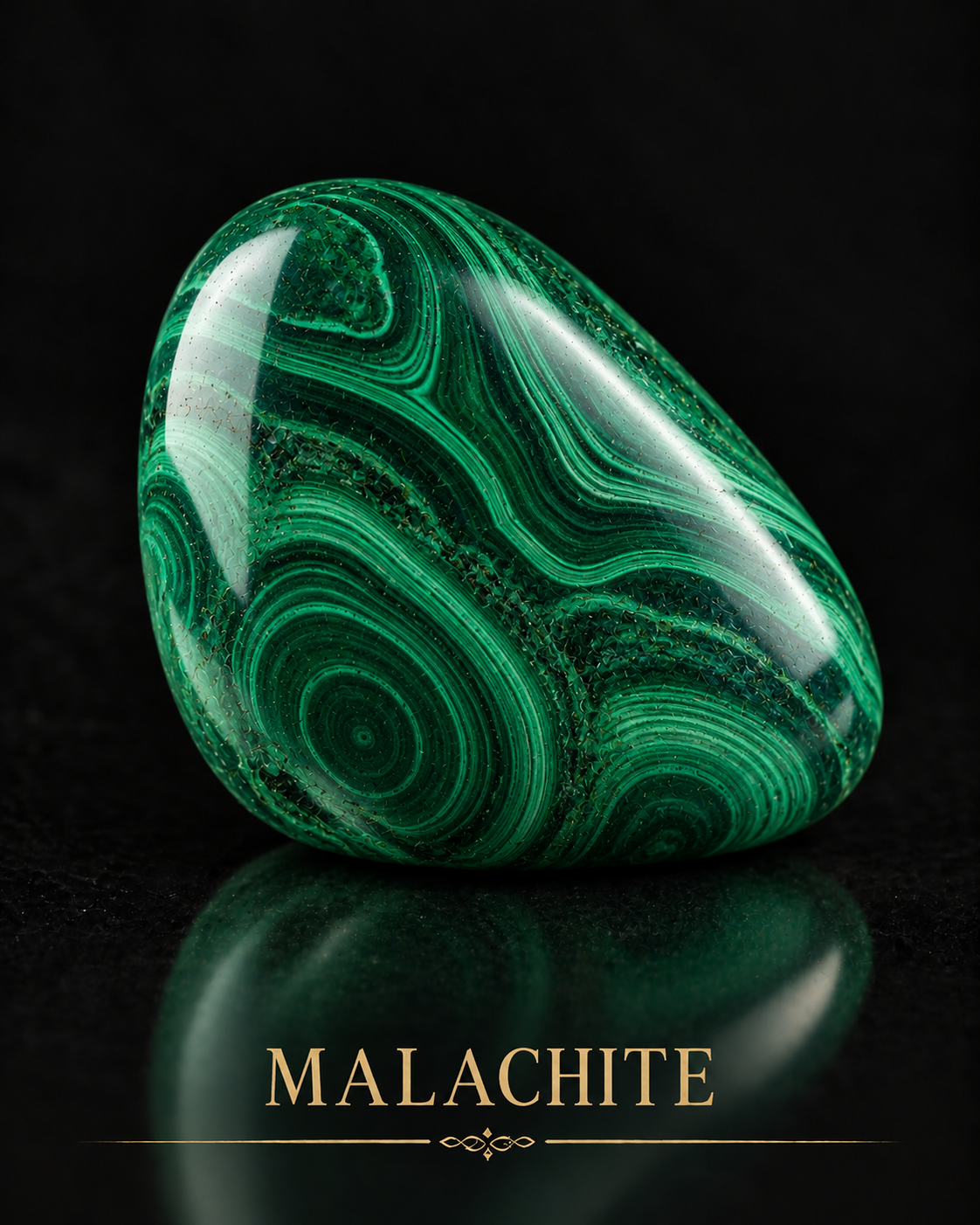
Malachite brings a restless green to the collection. Its bands curve, gather and turn back on themselves, creating a surface that can feel almost drawn. In the generated study, a polished rounded form emerges from black. Pale reflections cross the green without entirely concealing the pattern beneath, while its reflection settles into the dark ground.
The material opens several connected enquiries: the preparation of colour in ancient Egypt, mineral formations in Central Africa, and the green pigments of European painting. These histories give the stone more than a decorative role. They invite attention to how a material moves between the earth, the body, the workshop and the image.
Reading the green surface
Malachite is a copper carbonate mineral. GIA describes its close association with blue azurite in exposed copper deposits and gives both minerals a Mohs hardness of approximately 3.5–4. Their shared geological setting helps explain why blue and green sometimes appear together in one worked piece.
A polished malachite surface offers an artist two kinds of movement. The outline establishes the stone’s overall volume, while its internal pattern directs the eye across that volume. A band can lead towards a highlight, disappear beneath it and reappear on the other side. The surface becomes a meeting of geological pattern and the light of the studio.
Those movements need room. Surround a patterned green with equally busy fabric or ornament and its rhythm may become harder to perceive. Set it beside a quieter passage and the bands can carry the visual interest. This is a compositional possibility rather than a meaning permanently attached to the mineral.
Egypt: colour worn around the eyes
The Metropolitan Museum of Art’s record for a New Kingdom cosmetic container explains that green eye paint was prepared from malachite. Minerals were ground on palettes, combined with fat and applied with an implement. The container itself, dated around 1550–1400 BCE, is glazed steatite, decorated with images of Bes; it is not carved from malachite.
That distinction allows the material and its equipment to tell a fuller story. The green passed through preparation before reaching the face. A mineral became a cosmetic through the decisions and actions of a person: grinding, mixing, storing and applying. The surviving container belongs to that practice, even though it is made of another material.
For portraiture, this suggests attending to the eye as a place where appearance is deliberately formed. A line of colour can change how a gaze is framed. Its position, thickness and relation to skin may matter more than its size. Historical cosmetic practices offer a way to think about the constructed face without treating every contemporary green accent as an Egyptian symbol.
Small fragments, specific places
The Met also holds fragments of malachite from a foundation deposit associated with Senenmut’s tomb at Deir el-Bahri. The record dates them to the joint reign of Hatshepsut and Thutmose III, around 1473–1458 BCE. Here the mineral survives as fragments with an excavated context, rather than as a finished jewel.
Such small things change the scale of the enquiry. A spectacular object can attract immediate attention; a fragment asks for a slower kind of looking. Its significance depends partly on where it was found and the record that accompanies it. The museum’s identification gives the green a particular historical setting.
An artist can respond to that difference between visual prominence and historical importance. A modest detail within a portrait may carry an association that is not immediately apparent. It can reward someone who returns to the work, much as a small fragment becomes more interesting when its context is understood.
Central Africa: a documented mineral landscape
A 2017 GIA mineralogical report identifies Katanga in the Democratic Republic of Congo as a substantial source of ornamental malachite. This establishes a regional connection for the material; it does not identify the source of the generated image or establish a route from Congo to the Egyptian objects discussed here.
GIA’s museum specimen called Atlantis provides a more individual example. From the Star of the Congo Mine near Lubumbashi in Haute-Katanga, it consists of malachite stalactite forms coated with blue chrysocolla. The museum explains their growth through copper-rich liquid dripping from a cave ceiling. Seen in its growth orientation, the specimen becomes easier to understand.
That change of viewpoint has an artistic lesson. The way a museum displays a form may differ from the way it developed. Turn an object, alter its lighting or change its scale and another relationship becomes visible. A convincing image can arise from considering the object’s structure before choosing the most striking presentation.
The African connection is therefore both geographical and material. It concerns a named place and the conditions of a recorded specimen. Contemporary interpretation can begin there while allowing the region to retain its specificity, rather than making the stone stand for an undifferentiated continent.
Renaissance greens and the painter’s choice
Malachite also entered painting as pigment. GIA’s historical review places its importance in European easel painting between the fourteenth and seventeenth centuries. A polished stone and a painted green are different appearances of material that has been worked for different purposes.
A National Gallery technical study of late fifteenth-century Florentine panels records common pigments in works by Botticelli, Filippino Lippi and the Ghirlandaio painters. Its list includes azurite and artificial malachite. The word “artificial” matters: evidence of a malachite pigment does not automatically establish that a natural gemstone was ground for that painting.
For a contemporary practice revisiting Renaissance methods, this encourages attention to the actual means of making colour. Historical influence can involve questions about preparation, texture and layering, as well as the appearance of a finished image. A digital simulation can explore those relationships through its own tools, provided its process is described accurately.
From banded stone to an artistic language
Malachite’s most useful contribution to a new artwork may be its rhythm. Repeat a curved band in a collar, a sleeve or a neighbouring ornament and the material begins to participate in the whole composition. The repetition can be subtle: one turn of a line may be enough to make the stone feel placed rather than added.
Its greens can also establish a relationship with skin and gold. A darker green may concentrate attention beside a warm face; a lighter band may echo the brightness of a metal setting. Let these decisions follow the subject. The material’s history supplies points of contact, while the artwork determines their emotional weight.
Egyptian preparation, a Congo specimen and Renaissance pigment research bring different kinds of evidence into view. Together they invite a practice that takes colour seriously as something made, handled and situated. Malachite offers a pattern to look at, and a history of work behind the act of looking.