MAKERS · SCULPTURE · JEWELLERY CRAFT
The Hands
Behind the Jewels
The makers, sculptors and designers whose craftsmanship I am looking towards.
Explore The Sovereign WithinExplore The Sovereign Within — Version Two
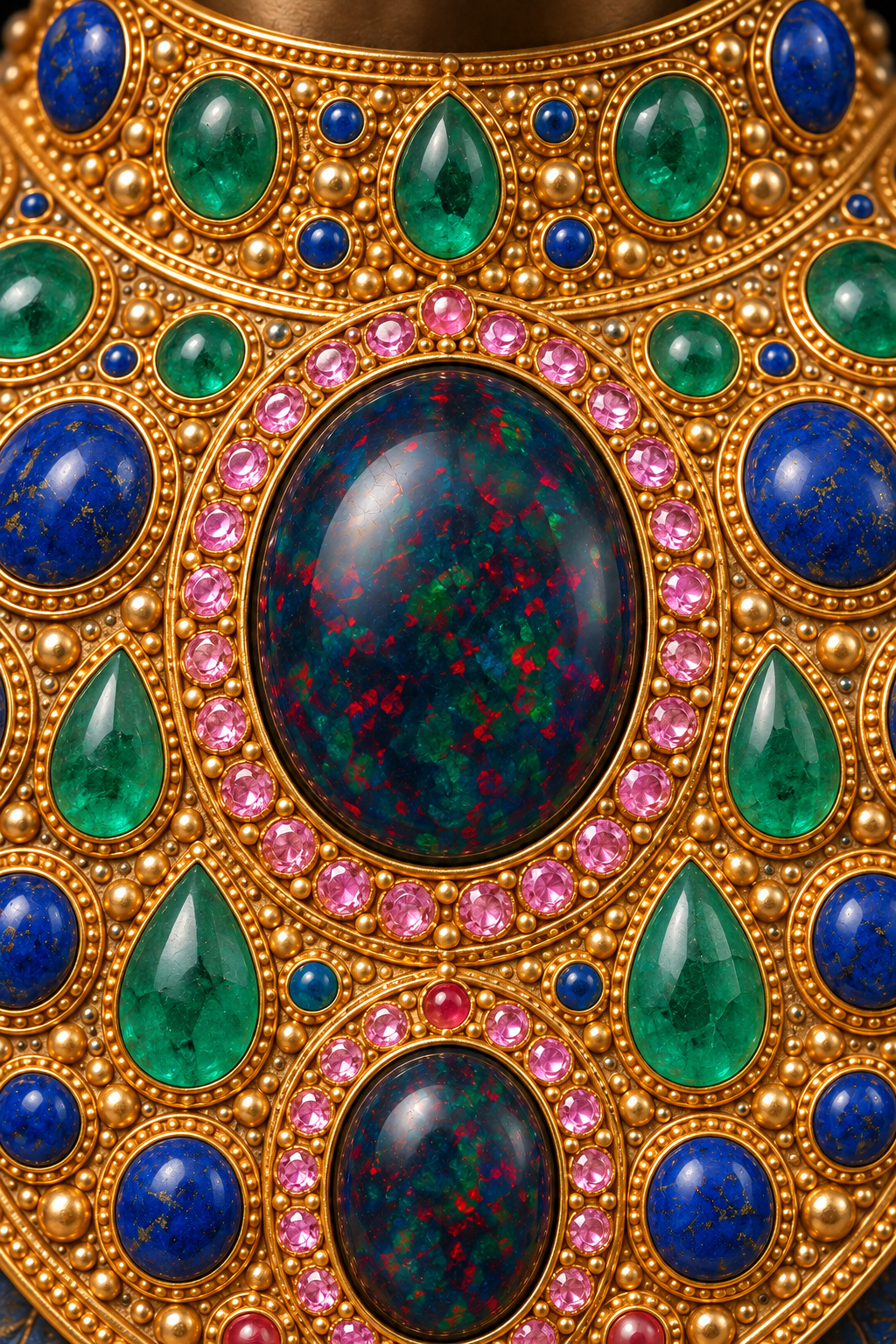
When I talk about the jewellery that interests me, I want to give attention to the people behind it. Someone has to decide how a line will turn, how deeply a surface should be engraved, how a stone will be supported and how the smallest part will belong to the whole. Those decisions are where craftsmanship becomes specific.
My admiration for that care helped shape The Sovereign Within. I wanted its crown and collar to reward close attention while sustaining the quiet emotion of the face. Fabergé was an inspiration. As I explore the wider history of jewellery, I am looking towards individual makers as well as houses: people whose work gives me a clearer understanding of what mastery can involve.
Benvenuto Cellini and René Lalique are two starting points. From them, I want to follow the conversation into the workmasters, goldsmiths, stone carvers and creative partnerships associated with Fabergé, Buccellati, Cartier, Van Cleef & Arpels and Boucheron. Their roles differ. Recognising those differences helps me give credit more carefully.
Benvenuto Cellini: the goldsmith thinking as a sculptor
Cellini gives me a way to connect sculptural presence with precious metalwork. The Kunsthistorisches Museum dates his Saliera to 1540–1543.1 This celebrated salt cellar is a useful reference because its purpose and its sculptural imagination occupy the same object.
What draws my attention is the possibility of a goldsmith thinking through the whole form. I want to consider proportion, the relationship between figures and ornament, and how a precious object can carry an idea. A jewel or a decorative object can offer the same invitation to sustained looking that I seek in sculpture.
In my bust, a face sits within an elaborate arrangement of stones and goldwork. I want those parts to belong to one composition. Looking towards Cellini encourages me to ask whether the ornament contributes to the presence of the figure, and whether the figure gives the ornament a purpose. I am exploring him as a reference point for that relationship, rather than claiming that his work directly shaped the original design.
René Lalique: choosing materials for what they can express
Lalique interests me through his judgement about materials. The Musée Lalique describes his movement from conventional precious stones and metals towards glass, enamel, horn, ivory and semi-precious stones. It identifies the visual result, rather than material cost alone, as central to that change.2
That is a useful challenge for me. When I choose a colour or a surface, I want to understand what it contributes to the work. A dark centre can hold the eye differently from a bright one. A softer reflection can make room for an expression. The value of a material within an image depends on these relationships.
Lalique gives me a reference for treating jewellery as an expressive art. I want the stones in The Sovereign Within to carry meaning alongside their visual richness. Wisdom, renewal, inner complexity, tenderness and vitality are the associations I am developing through its palette. Looking towards Lalique helps me ask how a material choice can serve the feeling of an object.
Fabergé’s workmasters: Mikhail Perkhin and Henrik Wigström
Fabergé’s name drew me into this conversation, but its workshop history leads me towards other names. The Royal Collection Trust identifies Mikhail Perkhin as Fabergé’s head workmaster from 1886 until his death in 1903.3 Naming a workmaster makes the labour behind a celebrated house more visible.
Henrik Wigström’s maker’s mark appears on the Colonnade Egg of 1910. The Royal Collection Trust describes bowenite columns, a pink guilloché-enamelled egg, sculpted figures and coloured-gold garlands, together with a clock movement supplied by Henry Moser & Cie.4 The object brings different materials and specialist contributions into a coherent design.
What I admire here is responsibility for the whole. A workmaster’s name should not make the rest of a workshop disappear. It gives us a point from which to recognise the coordination of many skills. I want to look at how carving, enamel, setting and metalwork meet, and how the final object holds those contributions together.
That changes how I talk about Fabergé’s influence on my own work. The inspiration includes the care of a workshop tradition. I want the same seriousness of attention in the image I direct, while recognising that my digital decisions are different from making and assembling a physical jewel.
Mario and Gianmaria Buccellati: the surface as a place of invention
Mario Buccellati brings the goldsmith’s attention to the surface into focus. Buccellati’s account associates his modellato engraving with sculptural relief and describes his tulle openwork as a pierced network of small openings. It also connects Gianmaria Buccellati’s naturalistic flower creations with segrinato, a dense engraved texture.5 These examples give me particular processes to consider.
A surface can describe more than shine. It can suggest a petal, cloth or the soft turn of a leaf. The spaces cut into metal can be as deliberate as the metal left behind. I am drawn to that control because intricacy in an artwork depends on the relationship between details, rather than their number alone.
I also want to recognise the craftspeople working alongside the Buccellati designers. The house describes a collaboration in which individual makers handle particular stages of production.5 Mario and Gianmaria give the discussion named creative figures; the engraving, piercing, assembly and finishing also require specialist hands.
For my crown and collar, the practical lesson is clarity. I want an edge to remain legible and a recess to have depth. Around the face, I want quieter bronze. The purpose of each area should guide how much detail it receives.
Cartier’s stone carvers: Philippe Nicolas and Émilie Marques
Philippe Nicolas offers a particularly direct connection between sculpture and jewellery. Cartier records the integration of his glyptics atelier into its high jewellery workshops in 2010. Glyptics concerns engraving and sculpting stone. The house’s account also identifies Émilie Marques, his former apprentice, as the leader of the atelier in its published description.6
I find the relationship between master and apprentice important. It makes craftsmanship a continuing practice: knowledge is demonstrated, tested and passed on. A technique survives through people learning to use it, and through the judgement they develop in doing so.
Stone carving also reminds me to look beyond a gem’s colour. A material has volume, edges, resistance and a relationship to light. In my digital work, I can represent some of those qualities, but the carver works with the material itself. Studying that distinction helps me be more precise about what I am trying to make convincing.
Van Cleef & Arpels: drawing, direction and the workshop
At Van Cleef & Arpels, Renée Puissant and René Sim Lacaze offer a documented example of creative collaboration. Puissant became artistic director in 1926. The house describes Lacaze translating her ideas into sketches, which she often annotated.7 Their contribution belongs to design and artistic direction; I want to distinguish it from the setting and metalworking carried out in the workshop.
The distinction gives each kind of work its due. A drawing can express an intention. Making the object requires further decisions about construction, finish and the behaviour of materials. Neither stage tells the whole story on its own.
The house’s Mystery Set technique, using specially cut stones inserted into gold rails, makes the technical demands more concrete.8 I am interested in the setters and lapidaries who resolve that work. Where individual names are not supplied in the sources, I want to acknowledge their roles without inventing an attribution.
Boucheron: Paul Legrand and Charles Glachant
A Boucheron object catalogued by Christie’s provides another useful distinction between design and execution. Its silver-and-glass vase and oil lamp, dated 1878–1880, carry a design attribution to Paul Legrand and maker’s marks for the silversmith Charles Glachant. The catalogue connects the work with Boucheron’s archival photographs and describes its patination, gilding, pierced surfaces and sculptural details.9
I find that specific object more revealing than a general statement about luxury. Legrand’s design attribution and Glachant’s marks allow us to discuss different contributions. The attribution is qualified, and I want to preserve that qualification. The physical marks give the maker a presence in the record.
What I take from this is a way of looking. A finished object may combine the imagination of a designer, the skill of a silversmith and the organisation of a house. Naming those contributions helps us see the achievement with greater care.
The attention I want to carry forward
These makers and creative partnerships give me several ways to think about mastery: Cellini’s meeting of goldsmithing and sculpture; Lalique’s expressive material choices; the coordination of Fabergé’s workmasters; Buccellati’s treatment of surface; Cartier’s stone carving and transmission of skill; and the relationship between design and execution at Van Cleef & Arpels and Boucheron.
I am exploring these references as I develop my practice. I do not claim their physical techniques as my own. The Sovereign Within is an artist-directed, AI-assisted digital artwork, with simulated bronze, gold and gemstones. My responsibility lies in its intention, selection, refinement and presentation.
I want my attention to detail to have an emotional purpose. In the macro studies, a viewer can look closely at a setting, an earring or the bronze eyelids. In the full image, those details need to return us to the face. That is the question I carry from this study of craftsmanship: how can each small decision help a work hold someone’s attention?