ARTICLE EIGHT · MATERIAL INTELLIGENCE
The Intelligence of Imperfection
Why asymmetry, correction, broken surfaces and restrained irregularity were essential to making a digitally reconstructed Renaissance painting feel human.
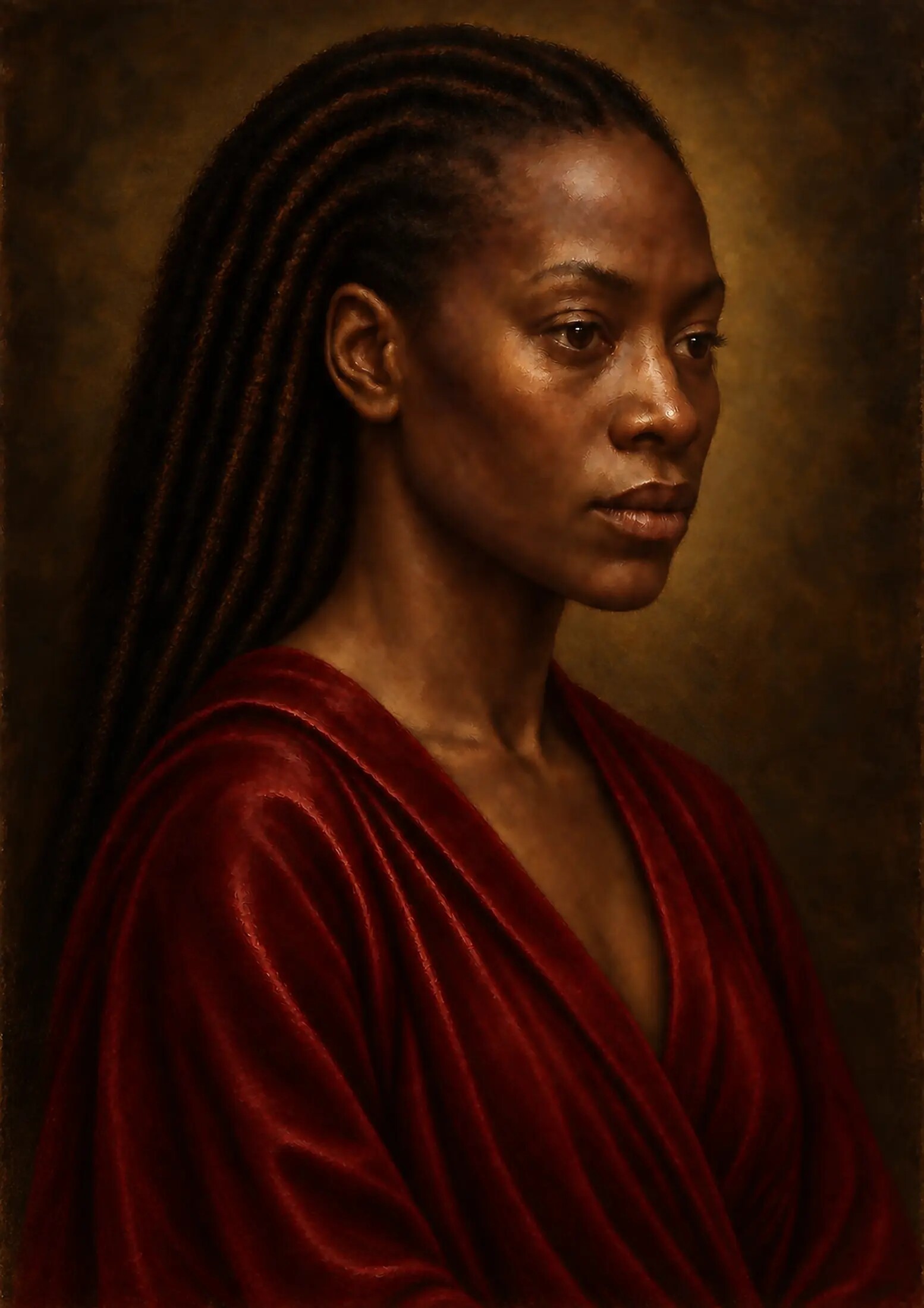
The central question was not how to make the work look damaged. It was how to prevent perfection from making it feel dead.
In this eighth article accompanying Painting Without Wet Paint, Jabbi Delahaye examines how asymmetry, revision, layered time and material resistance preserve evidence of human judgement.
A digitally constructed image can be almost too clean.
Lines meet without hesitation. Gradients move without resistance. Textures repeat with mathematical consistency. Two eyes become perfectly balanced. Skin loses its variations. Every edge receives the same degree of definition, and every area of the image appears to have been completed at the same moment.
At first, this precision can look impressive. Under prolonged inspection, however, it often produces a strange absence. The image contains information, but little evidence of discovery. It may show the appearance of a painting without suggesting that anything was ever painted.
In this eighth article accompanying Painting Without Wet Paint, I examine the role of imperfection in the construction of the Renaissance-inspired portrait: not error for its own sake, not artificial distress applied to make a new image appear old, but meaningful irregularity arising from structure, material behaviour, revision and human judgement.
The central question was not how to make the work look damaged.
It was how to prevent perfection from making it feel dead.
The Problem With Perfection
A perfectly smooth surface is easy to recognise as digital.
This does not mean that every digital image must be rough, distressed or visibly textured. Smoothness can be purposeful. Precision can be beautiful. The problem begins when smoothness is applied indiscriminately—when skin, fabric, hair, metal and darkness are all resolved through the same uninterrupted finish.
Physical paintings resist this kind of uniformity.
Linen is not perfectly regular. A prepared ground contains slight variations in tooth and absorbency. A drawn line changes with pressure. A brush deposits more paint at one moment and less at another. Transparent colour gathers differently from opaque paint. Corrections disturb earlier decisions. Drying, handling, environmental conditions and time add further variations.
Even a highly controlled painting contains difference.
The digitally reconstructed portrait therefore needed more than simulated brush marks. It needed the visual consequences of a process in which every layer did not behave identically.
Its irregularities had to possess causes.
A broken passage in the hair needed to follow the direction of the form. A thicker highlight needed to correspond to illumination and emphasis. A faint line beneath the colour needed to suggest an earlier drawing decision. A small difference between the eyes needed to belong to the sitter’s structure and expression.
The objective was not to imitate mess.
It was to reconstruct resistance.
Imperfection Is Not the Opposite of Skill
The word imperfection can be misleading.
It may suggest carelessness, technical weakness or a romantic belief that anything rough is automatically authentic. None of these ideas governed the work.
A misplaced eye remains a misplaced eye. An inconsistent light source does not become expressive simply because it is irregular. Random brush marks do not create artistic freedom. Cracks scattered across a surface without regard for paint thickness, support or age do not make an image historically convincing.
There is an important difference between error and living variation.
An error weakens the internal logic of the work. Meaningful irregularity strengthens it.
The artist must therefore know what is being disrupted. Asymmetry only becomes convincing when the underlying anatomy is understood. Broken brushwork is most effective when it follows the form beneath it. A lost edge carries meaning because another edge has been deliberately found.
Control makes release possible.
This principle can be seen throughout Renaissance and early Flemish painting. The most persuasive works are not convincing because every section has been polished to the same degree. They are convincing because control is distributed intelligently. Some passages are exact. Others remain abbreviated. Certain contours are firm; others dissolve. Precious details emerge from quieter areas because the painter has understood where precision matters.
The intelligence lies in the distribution.
A Painting Should Contain Time
A physical painting records duration.
Even when its surface appears calm, it was not made all at once. The support was prepared. The composition was established. Forms were drawn, adjusted, covered and recovered. Paint dried between stages. Transparent layers modified opaque ones. Highlights were returned to after shadows had deepened.
The finished surface contains these different moments.
A digital image often collapses time. It can appear to have arrived instantaneously and everywhere at once. Every component possesses the same degree of presentness. Nothing appears to lie beneath anything else.
To reconstruct the visual logic of a historical painting, the portrait needed to suggest sequence.
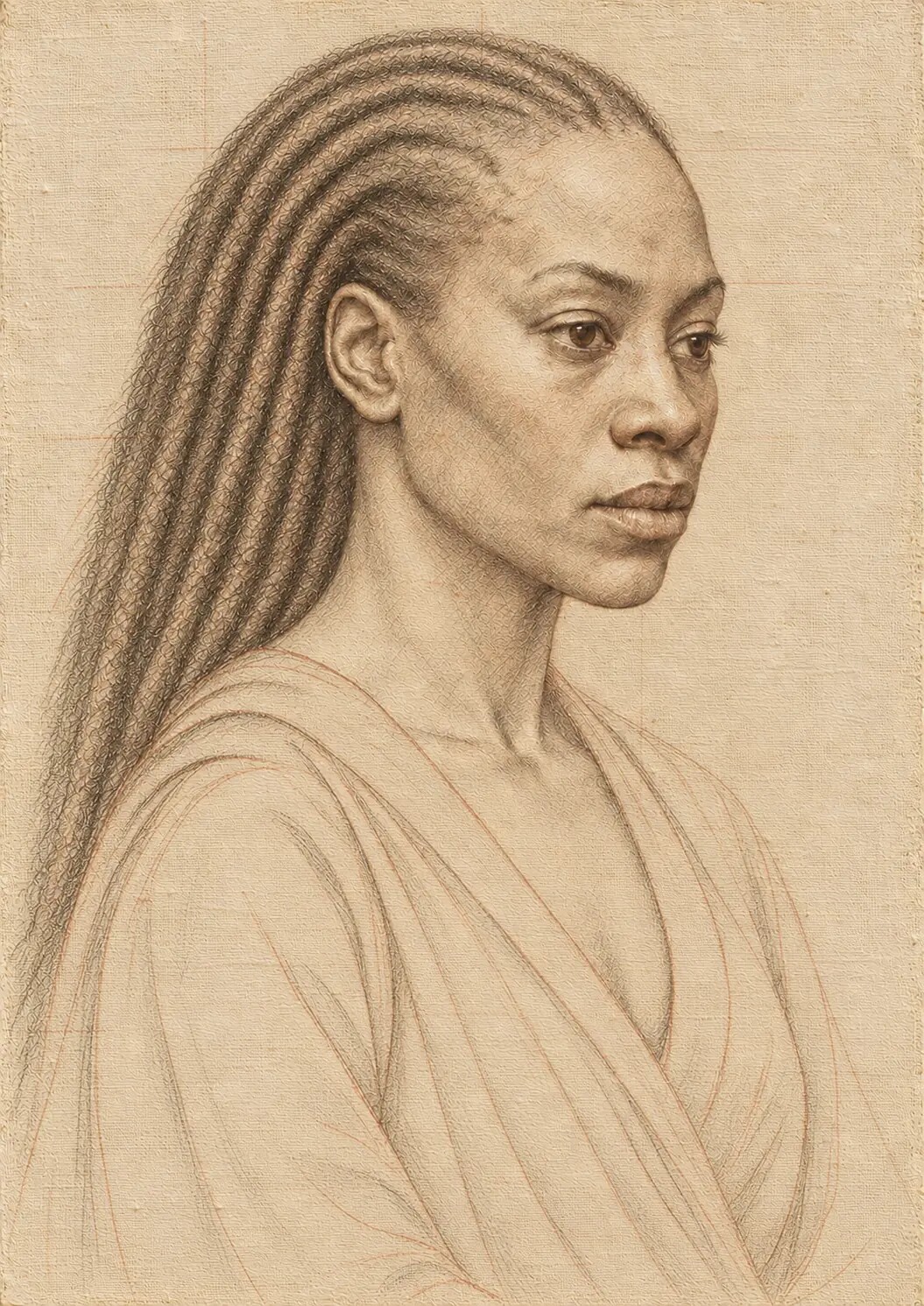
The linen came before the ground.
The ground came before the drawing.
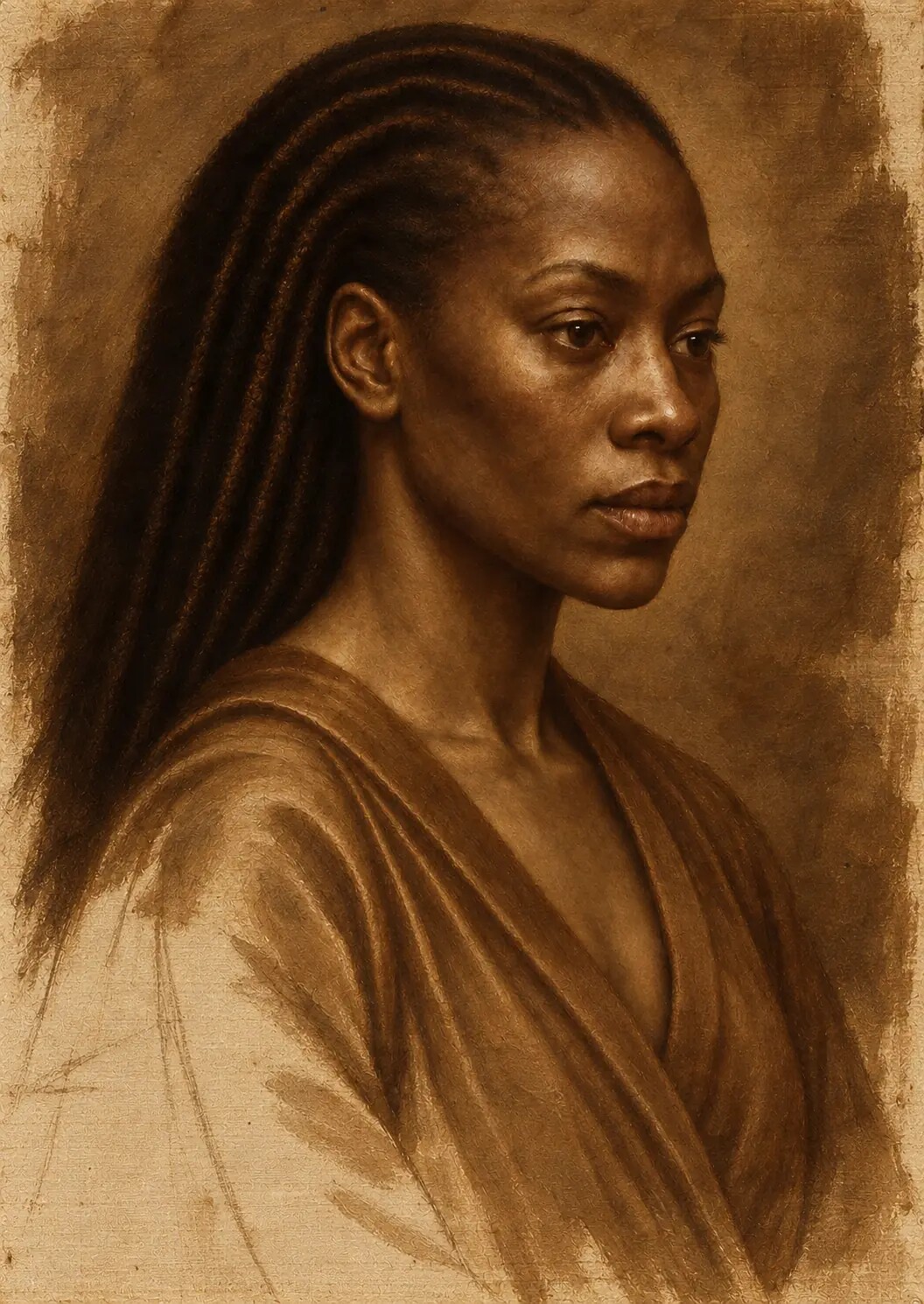
The drawing came before the tonal modelling.
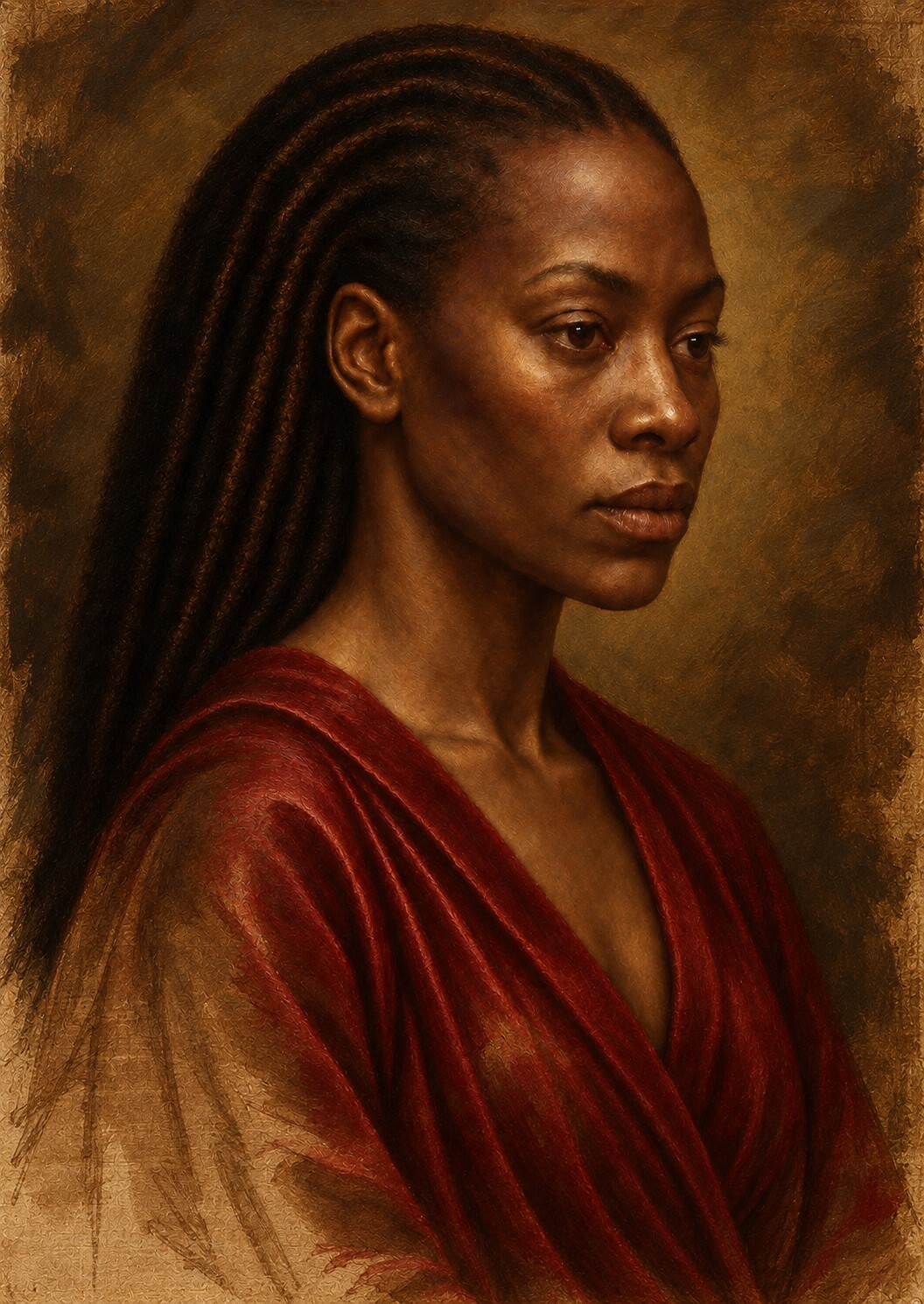
The underpainting came before full colour.
Muted colour came before saturation.
Opaque form came before transparent depth.
Glazing was interrupted by scumbling.
Fine detail arrived only after the broader structure had been established.
Some of those stages became almost invisible, but they remained active in the final image. A trace of underdrawing could survive beneath a lighter passage. A cool tone could continue to influence warm flesh. A broad early brush mark could remain partly perceptible beneath refinement.
This created an essential feeling: that the visible surface had a past.
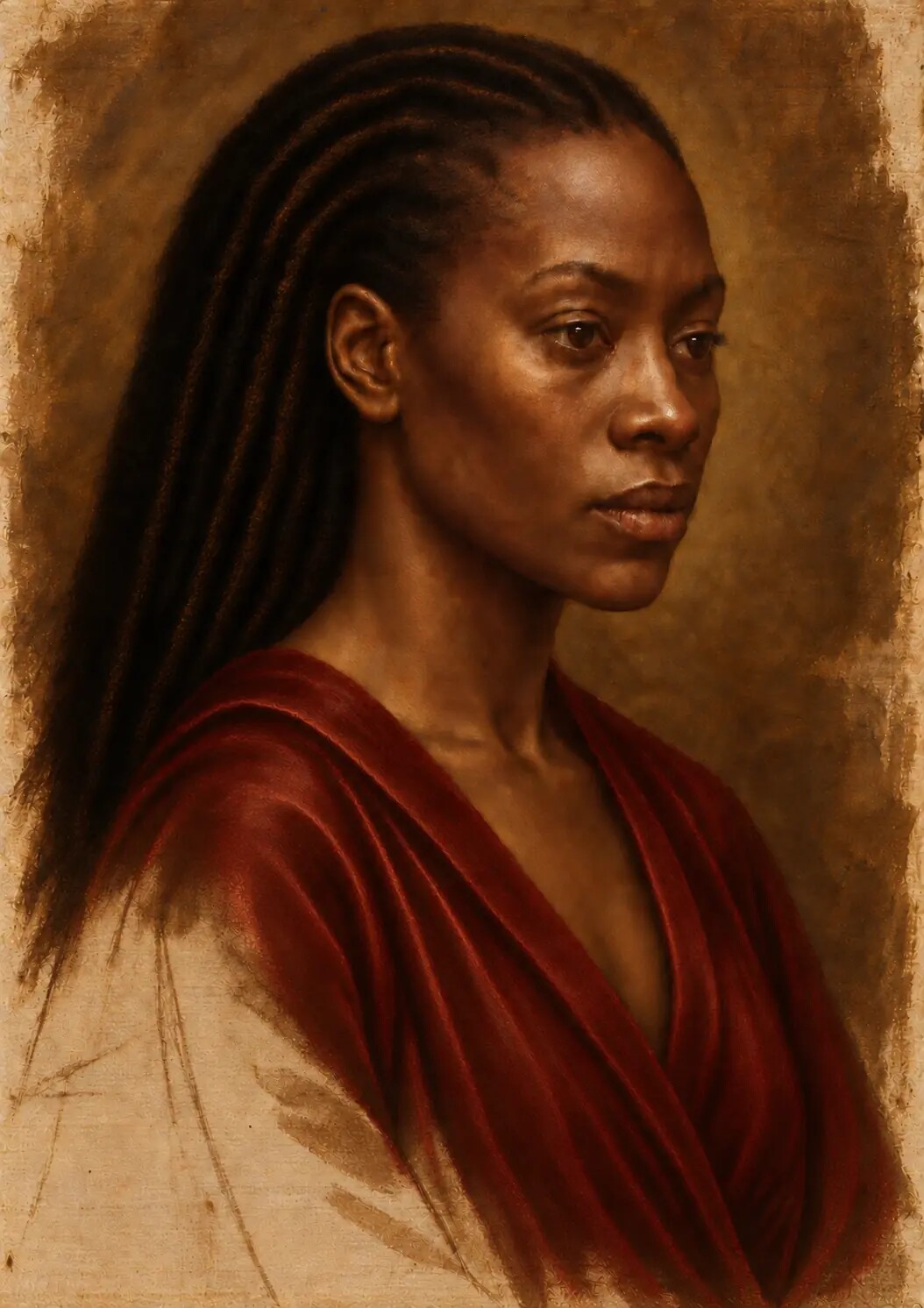
Pentimenti and the Evidence of Revision
One of the most revealing qualities in an old painting is the presence of change.
A hand may have been repositioned. A contour may have shifted. The angle of a garment may have been revised. An earlier line may become visible as paint layers age or as technical imaging reveals what lies beneath the surface.
These changes are often described as pentimenti, from an Italian word associated with repentance or change of mind. They matter because they show that the image was discovered through work. The final composition was not simply transferred in perfect form from an untouched idea.
Technical examination has revealed such changes in many historical paintings. Infrared imaging, X-radiography and microscopic analysis can expose underdrawing, abandoned contours and alterations that cannot be seen easily with the naked eye. A Getty conservation study of historical paintings, for example, describes how infrared examination disclosed changes to the positions of hands and a sword in Antoine Dubost’s The Sword of Damocles.
These discoveries complicate the fantasy of effortless mastery.
Mastery did not always mean knowing the entire answer before beginning. It often meant recognising when the answer needed to change.
Within the digitally reconstructed portrait, the equivalent of pentimento was not used to fabricate a false archaeological history. It was used to preserve the logic of revision.
Some underlying marks were permitted to remain faintly visible. Not every adjusted contour was erased completely. Certain transitions retained evidence that another solution had once been considered.
The effect is quiet. The viewer may not consciously identify a corrected line, but its presence can prevent the surface from feeling sterile.
The painting appears to have been worked through rather than merely delivered.
The Underdrawing Was Not a Perfect Outline
A modern digital outline can be perfectly even. It can maintain the same thickness, darkness and certainty around an entire figure.
That consistency would have been inappropriate for the underdrawing.
The drawing beneath the portrait needed to behave as a search for structure. Pressure varied. Some marks were decisive; others were exploratory. Lines strengthened where proportion had been resolved and weakened where forms would eventually dissolve into shadow.
The face did not need an enclosing contour. It required an arrangement of structural decisions.
The eye socket, jaw, mouth and garment were constructed through marks of different weight. Some lines described boundaries. Others measured direction or located shadow. A few were allowed to pass slightly beyond their final destination, suggesting that the hand—or its digital equivalent—had moved through the form rather than tracing around it.
This did not mean reproducing every accidental mark that might occur on paper or prepared linen. Too many visible construction lines would have turned the drawing into a performance of indecision.
The retained marks needed to serve the final painting.
A faint trace near an eyelid could add depth to the feature. A buried garment line could suggest that the drapery had been adjusted. A partially visible contour could prevent a pale passage from becoming digitally sealed.
The drawing became evidence of thought precisely because it was neither perfectly clean nor arbitrarily chaotic.
Asymmetry and the Face
The face was one of the most important places in which perfection had to be resisted.
Human faces are not mirror images. One eye may open more fully. One brow may rise slightly higher. The mouth may carry more tension on one side. The cheeks, nostrils and jaw may differ in ways that become more visible under directional light.
Digital construction can easily reduce these differences.
A generated face may begin with apparent asymmetry but become increasingly standardised during refinement. Correcting one eye can lead to the other being matched too closely. Smoothing the skin can remove differences in volume. Attempts to make the portrait more beautiful can gradually erase the individual structure that made the face compelling.
The aim was not to exaggerate asymmetry. It was to preserve difference where difference carried life.
The eyes were examined separately and as a pair. They needed to share a gaze without becoming duplicates. The mouth needed structural unity without perfect balance. The distribution of light across the face needed to respond to the turn of the head rather than divide it into two equal halves.
This was especially important because the portrait draws upon a visual tradition that has frequently converted the human subject into an ideal.
Idealisation can create dignity and symbolic authority, but it can also erase specificity. Features become corrected towards a standard. Skin becomes polished into an abstraction. Individual presence is exchanged for an inherited idea of perfection.
In this portrait of a Black woman, that question carried further weight. The aim was not to place a generic face inside the costume and atmosphere of Renaissance authority. Her features needed to retain individual structure, gravity and presence.
She had to appear represented, not standardised.
Irregularity Is Not Ugliness
To resist idealised perfection is not to reject beauty.
The two have often been falsely opposed. Beauty is treated as smoothness, symmetry and flawlessness, while irregularity is treated as damage that must be corrected.
Painting offers a more complex understanding.
A face can be beautiful because it contains tension. A gaze can hold attention because the two eyes are not mechanically identical. A mouth can appear more alive because one corner carries a different pressure from the other. Skin can feel luminous because warmth and coolness are unevenly distributed.
Difference gives beauty its location.
Without variation, beauty becomes generic. It belongs everywhere and therefore nowhere. It resembles a category rather than a person.
The portrait’s irregularities were not added to diminish the sitter. They protected her from being dissolved into a polished type.
This distinction matters in digital and AI-assisted image-making, where systems can reproduce dominant conventions of attractiveness with remarkable fluency. Faces may become increasingly smooth, balanced, youthful and familiar. Their technical finish improves while their individuality weakens.
Artistic judgement was required to interrupt that tendency.
The Uneven Surface of Skin
Skin presented a particular challenge because it had to feel continuous without becoming uniform.
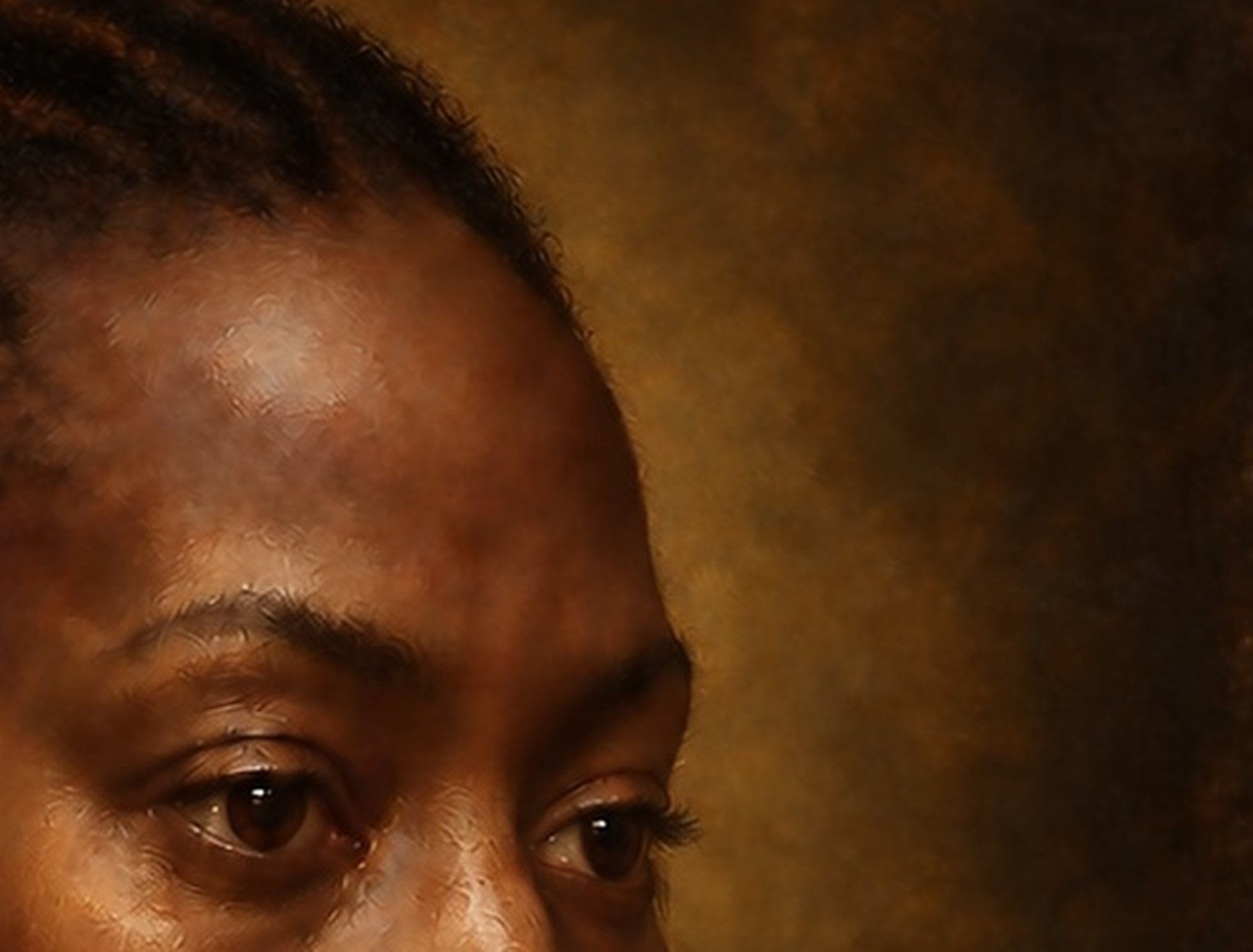
At normal viewing distance, the face needed to read as a coherent form. At macro scale, it needed enough variation to avoid plastic smoothness. These demands could not be satisfied by applying a generic pore texture across the entire face.
Real surface variation changes with anatomy, light and distance.
The forehead does not carry texture in precisely the same way as the eyelids. The side of the cheek does not reflect light in the same way as the bridge of the nose. Texture becomes less visible as a plane turns into shadow. Fine detail softens as the face recedes.
The simulated skin therefore required selective irregularity.
Small tonal interruptions were introduced where they supported the form. Pores and minute changes in reflectivity remained subordinate to the larger modelling. Warmer and cooler passages prevented the flesh from becoming a single polished colour.
Just as importantly, detail was removed.
Repeated patterns were softened. Marks that resembled a procedural texture overlay were broken apart. Surface information that did not correspond to the anatomy was reduced.
At macro scale, some of these corrections appeared to decrease the amount of detail. At normal viewing distance, however, they increased credibility.
This revealed a larger principle: naturalism does not depend upon the quantity of visible information. It depends upon the relationship between information and structure.

Hair as Organised Disorder
Hair easily exposes artificial regularity.
If every strand is individually drawn, equally sharp and evenly spaced, the hair begins to resemble wire. If it is treated only as a smooth mass, it resembles moulded plastic. Convincing hair exists between these extremes.
The broad shape came first.
The hair established a silhouette, weight and direction around the head. Large masses entered shadow before individual strands were considered. This allowed some areas to remain almost entirely quiet while selected passages received greater articulation.
Strands emerged in irregular groups. Their spacing, length, brightness and visibility changed. Some caught the light; others disappeared into the mass beneath them. A few crossed neighbouring directions, but most followed the larger movement of the form.
This was not randomisation.
Each strand belonged to a directional rhythm. The irregularity made sense because the larger structure remained intact.
Highlights were also restricted. If every strand carried a bright edge, the hair would have competed with the face and fragmented the head. Concentrating light in selected groups gave the hair life while preserving the hierarchy of the portrait.
The result depended on organised disorder: enough variation to avoid repetition, enough structure to prevent noise.
Fabric, Fold and the Broken Mark
The clothing required another kind of irregularity.
Fabric is shaped by gravity, tension, compression, weight and movement. A fold does not exist as a decorative line. It arises because the material is pulled, supported or allowed to fall.
The brushwork—or digitally reconstructed suggestion of brushwork—had to follow these forces.
Broad strokes established the principal folds. Smaller broken passages described changes in the surface. Areas that turned away from the light remained thinner and more absorbent, while selected ridges received more opaque colour.
The marks were not evenly distributed.
A focal fold near the face might contain greater definition. A lower or more distant passage could be simplified. Ornament could become precise in one section and dissolve in another.
This variation prevented the clothing from looking like a flat pattern placed beneath the head.
It also allowed the garment to perform its compositional role. The clothing carried colour, weight and material richness, but it remained subordinate to the sitter’s presence.
Imperfection here was a form of hierarchy. Not every thread needed to be visible. Not every fold deserved equal emphasis.

Brushwork as a Record of Pressure
A convincing brush mark contains more than direction.
It suggests pressure, speed, loading and contact with a surface. Paint may begin thickly and end thinly. A bristle may divide a stroke into parallel strands. The edge of a loaded brush may leave a slight ridge. Dry paint may skip across the tooth of a ground.
Random painterly texture cannot reproduce these relationships.
To suggest the hand of the painter, marks needed to vary according to what they were describing:
- curved strokes followed facial volume;
- softer feathering joined flesh transitions;
- firmer accents defined focal features;
- diagonal and vertical movement supported drapery;
- broken strands described hair;
- broader, quieter passages built the background;
- small loaded marks created selected highlights.
Some marks were partly covered by later passages. Others remained visible. A few functioned as corrections, interrupting earlier edges.
This partial burial was important. If every simulated brushstroke remained fully visible, the surface would become decorative. Painting is not simply a collection of marks placed side by side. Later decisions frequently modify or obscure earlier ones.
The surviving brushwork needed to look inherited from a process.
Variation in Apparent Paint Thickness
Historical oil paintings often contain significant differences in paint thickness.
Shadow passages may be thin and transparent. Flesh lights may become more opaque. Small highlights may rise more strongly from the surface. The physical relief can catch light and change as the viewer moves.
A two-dimensional digital master cannot reproduce that actual material behaviour. It can only suggest it visually.
Apparent thickness was therefore introduced through changes in edge, opacity, highlight and texture. Some brush marks seemed to gather paint at their boundaries. Selected highlights appeared more loaded. Dark glazed passages remained comparatively thin.
These differences were restricted.
If every area appeared heavily textured, the hierarchy would collapse. Universal impasto would make the skin, hair, background and fabric seem to be made from the same substance. It would also risk making the painting look artificially embossed.
The strongest suggestion of thickness belonged to a limited number of accents: small lights on the face, parts of the garment and selected points of ornament.
Elsewhere, the paint appeared thinner, smoother or more absorbed into the ground.
The surface became convincing through contrast rather than maximum relief.
The Linen Could Not Become a Screen Door
Canvas texture is one of the quickest ways to make a digital image resemble a superficial painting filter.
A regular weave is placed over the entire image. The same lines remain equally visible in the face, hair, shadow, clothing and highlights. Instead of suggesting a support beneath paint, the texture sits on top like a screen.
The simulated linen required a more complicated relationship with the image.
Its scale needed to agree with the intended physical dimensions of the work. The weave contained slight irregularities rather than repeating as a perfect grid. More importantly, its visibility changed according to the imagined paint layer above it.
In thin passages, the weave could remain more apparent.
Beneath opaque flesh lights, it became quieter.
In broken scumbles, the tooth could interrupt the colour.
In deeper glazed areas, the surface needed to remain visible without becoming brighter than the shadow itself.
The texture also had to respond to the painting’s illumination. It could not cast identical highlights across every region.
This made the support feel buried within the painting rather than printed over it.
The Ground Beneath the Surface
The prepared ground contributed another level of controlled variation.
A perfectly flat digital background would have given later layers no resistance. A violently distressed one would have competed with the portrait. The ground therefore contained a restrained tooth: minute scratches, small changes in absorbency and subtle tonal movement.
These irregularities were most effective when they remained almost invisible.
Their role was not to become a feature. They disrupted digital uniformity and influenced the way subsequent layers appeared to sit upon the support.
In lighter, thinner passages, the pale ground contributed to luminosity. In broken paint, it appeared briefly between marks. In deeper areas, it remained perceptible only as a change in surface behaviour.
The ground did not demand attention, yet the painting would have felt different without it.
Imperfection often works in this way. Its influence is greater than its visibility.
Why Random Noise Fails
Digital tools can add noise, grain, scratches, dust, fibres and surface marks almost instantly.
These additions are sometimes mistaken for material realism. Yet random noise rarely creates a convincing painted surface because it has no relationship to the depicted objects.
A scratch crosses skin, hair and fabric without changing.
A grain pattern remains equally visible in light and darkness.
A crack passes through thin glaze and thick highlight as though every layer possesses the same structure.
The image becomes busier but not more physical.
Material credibility requires conditional variation. Texture must respond to location, layer, form, lighting and scale.
This is why the portrait was inspected repeatedly at macro and micro levels. Mechanical repetition often hides at normal viewing size. Enlargement reveals duplicated pores, identical fibres, suspiciously even spacing and marks that continue across unrelated surfaces.
Once identified, these patterns were not necessarily removed entirely. They were interrupted, softened or integrated into the forms beneath them.
The purpose of inspection was to discover where an apparent imperfection had become another kind of perfection: a repeated digital system.
Craquelure Is a History, Not a Pattern
Craquelure—the network of cracks that develops as paint layers age and shrink—is one of the most recognisable signs of an old painting. The National Gallery’s glossary explains that oil and tempera paintings commonly develop complex networks of surface cracks and that cracking may extend into the varnish.
This does not mean that any crack pattern will create historical credibility.
Craquelure is a consequence of materials, structure, age and environmental conditions. Its appearance can vary according to the support, ground, paint layers, thickness, drying behaviour and later treatment of the work.
A uniform cracking filter ignores all of this.
Applied indiscriminately, it can make a face look like dry earth, porcelain or aged leather. It can also overpower colour and destroy the illusion of soft flesh. Rather than making the image appear older, excessive craquelure announces the attempt to make it appear old.
The portrait therefore used cracking, where present, with restraint.
It was not equally visible everywhere. It did not become a decorative net thrown over the image. It remained secondary to anatomy, light and paint structure.
Most importantly, it was not used as proof of authenticity.
The work is contemporary. Its digital master has not physically aged. Any craquelure is a visual reference to the material history of painting, not evidence that this particular object has survived for centuries.
That distinction protects the honesty of the work.
Ageing Without Counterfeiting
There is a difference between historical atmosphere and fabricated antiquity.
Historical atmosphere can emerge through composition, lighting, colour, surface restraint and the visual language of layered painting. Fabricated antiquity relies on exaggerated yellowing, random cracks, darkened corners, stains and distress.
The first approach learns from historical objects.
The second imitates their damage.
The painting was not intended to deceive anyone into believing that it was a newly discovered Renaissance artefact. It is a contemporary digital artwork that openly reconstructs aspects of historical painting within another medium.
The simulation of age therefore remained limited to plausible optical suggestions:
- slight warmth associated with a final surface;
- modest irregularity in the ground;
- restrained evidence of wear;
- gentle tonal settling;
- selective cracking rather than a universal overlay;
- variation in gloss and absorption;
- faint traces of underlying stages.
Colour luminosity had to survive.
The skin could not be buried beneath a brown veil merely to signify age. Jewel-like colours could not be reduced to mud. Deep blacks required articulation rather than arbitrary fading.
A historical painting is not convincing simply because it looks dirty.
Letting a Painting Age Gently
Conservation provides a useful lesson in restraint.
When historical works are treated, the objective is not always to make them appear newly painted. Conservators must balance structural stability, visual coherence, historical evidence and respect for the object’s material life.
In a Getty account of the conservation of Lucas Cranach the Elder’s Adam and Eve, senior conservator Ulrich Birkmaier describes the danger of going too far and turning treatment into artifice. His observation that old paintings must be allowed to “age gently” is particularly relevant to digital simulation.
The surface should not become a catalogue of historical effects.
Cracks, abrasion, discolouration and varnish warmth may all occur in old paintings, but combining them at maximum intensity produces caricature rather than history.
Restraint allows the work to retain both age and life.
For the digitally reconstructed portrait, this meant asking whether each ageing effect contributed to the image’s atmosphere or merely advertised itself. If it disrupted the face, confused the light or covered important colour relationships, it was reduced.
The painting needed gravity, not decay.
The Imperfection of Colour
Perfectly controlled digital colour can also become lifeless.
A sampled colour may remain identical across a large area. Shadows may be produced by lowering brightness. Highlights may be created by moving towards white. Saturation may be applied evenly.
Historical painting offers a different model.
Colour changes through layering. A warm glaze may pass over a cool underpainting. An opaque highlight may interrupt a transparent shadow. The ground may show through a thin area. Two passages that appear similar from a distance may be constructed from different combinations beneath the surface.
The portrait’s colour therefore required internal variation.
The flesh contained warm and cool relationships rather than one ideal skin tone. Dark fabric held traces of reflected colour. The background contained subtle temperature changes rather than empty black. Jewels and metallic details drew environmental colour into their reflections.
None of these areas needed to become visibly multicoloured. The variation remained organised within a dominant impression.
This is another form of intelligent imperfection: the refusal of colour to remain identical to itself.
Broken Scumbling and Uneven Glaze
Glazing and scumbling became central to the surface because they allowed colour to be modified without erasing everything beneath it.
A glaze was not applied as a perfect transparent sheet. It accumulated differently around forms and within shadow. Some passages became deeper; others retained more of the underpainting.
Scumbling was equally uneven. Lighter semi-opaque colour caught selected areas while allowing darker layers to remain visible through broken edges.
These differences suggested contact with a textured surface and a hand applying material under changing pressure.
The alternation between glaze and scumble created a visual rhythm:
transparent against opaque;
smooth against broken;
absorbed darkness against reflective light;
thin shadow against loaded accent.
If either process had been applied uniformly, it would have ceased to look like a material event. The irregularity was what allowed the layers to remain perceptible.
Lost Edges and Incomplete Description
One of the most important imperfections in the portrait is the refusal to describe every boundary completely.
A digital selection can create an exact edge around a figure. Every hair, shoulder and fold can be separated clearly from the background. This may appear precise, but it can flatten the relationship between figure and space.
The portrait instead used lost and found edges.
Part of the jaw remained visible while another section dissolved into shadow. Hair merged with the darkness before re-emerging in a small highlight. A garment edge became firm near a focal passage and softer elsewhere.
The viewer completes what the image withholds.
This incompleteness is not a technical failure. It activates perception. The mind joins interrupted contours and infers forms that have not been fully stated.
It also creates atmosphere. The figure belongs to the darkness because parts of it are allowed to enter that darkness.
A completely enclosed figure stands in front of its background.
A partially dissolved figure inhabits it.
What Macro Inspection Revealed
The portrait was repeatedly examined at extreme enlargement.
This process revealed defects that were almost invisible at ordinary scale:
- repeated pore structures;
- lashes arranged in identical intervals;
- hair strands with the same curve;
- highlights that contradicted the main light source;
- canvas texture crossing unrelated forms;
- abrupt transitions between generated or reconstructed passages;
- isolated areas of excessive sharpness;
- edges that resembled cut-outs;
- cracks with no relationship to the apparent paint;
- brush marks that ignored anatomy;
- texture that became more important than the sitter.
The response was not simply to add more detail.
In many cases, detail was the problem.
Patterns were broken. Sharpness was reduced. Transitions were rebuilt. Some marks were buried beneath quieter colour. Others were removed entirely.
The image often became more convincing when it contained less information.
Macro inspection was valuable because it exposed artificial regularity. The final judgement, however, was always made after returning to the full image.
A correction that succeeded at 400 per cent enlargement could fail at normal viewing distance. A beautifully irregular skin texture could become visual noise. A subtle lash could turn into an unwanted dark line. A crack could divide the face.
The whole painting retained authority over the detail.
Imperfection and Focal Hierarchy
Not every part of a painting should receive equal labour—or appear to have received equal labour.
The eyes and mouth required close construction because they carry psychological meaning. The face needed convincing anatomy because it forms the emotional centre. Secondary fabrics, ornaments and background passages could be simplified.
This hierarchy created differences in finish.
Some areas are resolved precisely. Others remain broad. A jewel may contain one decisive reflection while the surrounding ornament is only suggested. A hair strand may be sharp near the face and disappear further away.
If every region had been finished to the same microscopic degree, the viewer would have had no reason to look anywhere first.
Imperfection therefore included incompletion.
A painting does not need to exhaust every part of itself. It needs to provide enough information for each passage to perform its role.
The quiet areas are not missing detail.
They are protecting attention.
The Difference Between a Defect and a Decision
Throughout the process, every irregularity had to be tested.
The following questions helped distinguish meaningful variation from unresolved error:
- Does the asymmetry belong to the anatomy or expression?
- Does the brush mark follow the object’s form?
- Does the texture respond to lighting and paint thickness?
- Does a visible underdrawing mark suggest revision or simply look accidental?
- Does the lost edge strengthen space and atmosphere?
- Does the crack have a plausible relationship to the surface?
- Does the surface variation remain at the correct scale?
- Does the irregularity support the focal hierarchy?
- Does it remain convincing in print?
- Does it contribute to the whole painting rather than only to a macro crop?
An irregularity became a decision when it survived these questions.
This distinction is important because “imperfection” can otherwise become an excuse. Not every unresolved problem should be preserved in the name of authenticity. The painting still required exacting correction.
The intelligent surface was built through selection.
AI and the Tendency Towards the Plausible Average
AI-assisted imagery can produce extraordinarily rich visual information, but it also possesses characteristic tendencies.
It may regularise forms towards familiar patterns. It may create texture that appears persuasive locally but lacks structural meaning. It may produce near-symmetry where true symmetry should not exist. It may invent detail because detail is statistically associated with realism.
These tendencies are not corrected by asking for more beauty, more texture or more realism.
They require diagnosis.
The artist must identify what the image is averaging, repeating or smoothing away. A convincing passage may still need to be rejected if it weakens the individuality of the work. A less immediately polished alternative may contain a more useful structure.
This is where human judgement became decisive.
The technology could propose variations. It could assist in reconstructing a feature or testing a surface. It could not determine which imperfection carried truth and which merely simulated it.
The artist had to decide what should remain unresolved, what needed rebuilding and what had become too perfect to feel alive.
The Hand of the Artist in a Digital Atelier
The phrase “hand of the artist” is usually associated with physical marks: brush pressure, drawn lines, scraped paint and visible touch.
In a digital atelier, the hand is present differently.
It appears through direction, selection, interruption and refusal.
It is present when a polished passage is rejected because it lacks structure.
It is present when a generated symmetry is broken.
It is present when an over-bright eye is quietened, when false detail is removed and when a background is allowed to remain less resolved than the face.
It is present in the decision not to apply the same texture everywhere.
The digital hand does not need to imitate every physical gesture. Its deeper responsibility is to preserve judgement.
This is why the portrait cannot be understood only through the tool that contributed to its construction. Its authorship lies in the extended system of artistic decisions governing what was generated, accepted, corrected, integrated and discarded.
Imperfection became one of the clearest signs of that judgement because it could not be produced successfully through randomness alone.
The Print Will Introduce Its Own Irregularities
The transition from screen to physical print creates another material encounter.
A screen emits light. Paper reflects it. Ink interacts with a surface that may be smooth, fibrous, matte, glossy or textured. Deep blacks behave differently. Fine marks may soften. Highlights depend partly upon the colour and reflectivity of the paper.
The print therefore introduces real variation into a work whose painterly materials were previously simulated.
On Hahnemühle German Etching, the paper’s pronounced texture may reinforce the sense of a prepared surface and soften certain transitions. A smoother paper may preserve the smallest facial details more precisely. Fuji Pearl may introduce a different luminosity and reflective tension.
These surfaces should not be treated as neutral carriers.
Each one changes the relationship between precision and irregularity.
Proofing is essential because the simulated linen or paint texture in the file may interact unexpectedly with the physical paper. Two strong textures can compete. Fine craquelure may become too visible. Skin may appear rougher than intended. Dark passages may lose the subtle differences that prevented them from becoming empty black.
The print file may therefore require selective adjustment.
This is not a betrayal of the digital master. It is the continuation of the same process: observing how one layer changes the next and correcting the work in response.
Physical Texture and Visual Texture
The final printed artwork must also distinguish between two kinds of surface.
The first is visual texture contained within the image: simulated linen, brushwork, paint thickness, scratches, glazing, scumbling and restrained signs of age.
The second is the actual texture of the physical print: paper tooth, ink deposition, framing, glazing and any future raised-texture or UV process.
These are not interchangeable.
A flat fine-art print may convincingly depict thick paint while remaining physically two-dimensional. A raised UV print may create real relief, but that relief will only be persuasive if it follows the underlying brushwork and hierarchy of the image.
Applying equal physical height across the entire surface would repeat the same mistake as a uniform digital texture overlay. It would turn materiality into an effect.
Future raised-texture experiments should therefore preserve the painting’s variation:
- minimal relief in thin shadows;
- modest texture through broader passages;
- greater height in selected highlights;
- directional relief following brushwork;
- quiet areas where the surface is allowed to rest.
Physical imperfection, like visual imperfection, requires structure.
A Contemporary Work, Not a Simulated Relic
The painting’s historical references are deliberate, but its contemporary identity should remain visible.
It was constructed in a digital studio. AI-assisted processes contributed to the development of visual possibilities. Historical paint behaviours were studied and translated rather than physically reproduced. The final object will be realised through contemporary fine-art printing.
These facts are not weaknesses to be concealed.
They are part of the work’s meaning.
The portrait brings a Black female presence into conversation with visual traditions that once distributed authority, permanence and ideal beauty unequally. It uses contemporary technology to enter that history while remaining honest about its medium.
Its imperfections should therefore not be understood as attempts to disguise the work’s digital origin.
They are attempts to give the digital image internal time, material differentiation and evidence of judgement.
The work does not pretend to be old.
It asks what the accumulated intelligence of old painting can contribute to a new image.
The Surface as a Record of Decisions
When we stand before an old painting, we often respond to more than the depicted subject.
We respond to the sense that the surface has endured.
It has been made, revised, dried, varnished, handled, displayed, cleaned and altered by time. Some changes belong to the artist. Others belong to the material life of the object.
A newly created digital artwork cannot possess that same history.
It can, however, contain a history of decisions.
The portrait carries traces of drawing, correction, underpainting, muted colour, glazing, scumbling, sharpness, softness, addition and removal. Its surface does not emerge from one effect. It accumulates.
This accumulation gives the image resistance. It prevents the viewer from reading the work instantly as one seamless digital event.
The eye encounters difference and begins to move.
A sharp feature leads towards a softer edge. A smooth glaze meets a broken scumble. A luminous face enters textured darkness. A precise reflection rests beside a passage that remains almost unresolved.
The painting creates attention through inequality.
The Discipline of Knowing When to Stop
The final form of imperfection was the decision to stop.
Digital work can be revised indefinitely. There is always another edge to adjust, another pore to add, another transition to smooth and another texture to refine.
This apparent freedom can become destructive.
Each correction risks removing evidence of the process. Each added detail can weaken the hierarchy. Each attempt to improve symmetry can diminish individuality. Each effort to create realism can push the image closer to artificial perfection.
The work therefore required a threshold.
The portrait was complete when further intervention no longer strengthened its presence. A technically impressive detail could be removed if it distracted from the whole. A slightly unresolved passage could remain if greater precision made it feel mechanical.
Stopping was not an admission that no further change was possible.
It was a judgement that further change was no longer necessary.
Imperfection as Artistic Intelligence
The intelligence of imperfection lies in knowing where control should remain visible and where it should loosen.
It lies in understanding that a face needs asymmetry but not distortion; texture but not noise; age but not theatrical decay; brushwork but not random marks; detail but not uniform description.
The painting became more persuasive when its differences acquired purpose.
Its linen did not repeat perfectly.
Its drawing contained adjustment.
Its colour did not remain uniform.
Its glazes accumulated unevenly.
Its scumbles broke across the surface.
Its edges appeared and disappeared.
Its features resisted mechanical symmetry.
Its ageing remained restrained.
Its details were edited as carefully as they were added.
None of these decisions attempted to reproduce the physical reality of oil paint completely. That reality belongs to actual pigment, oil, ground, support, drying and time.
What the digital process could reconstruct was something else: the visual intelligence produced when an artist works through resistance, uncertainty and revision.
The final portrait does not feel alive because it is flawless.
It feels alive because its order contains difference.
Because the drawing remembers hesitation.
Because the surface contains more than one moment.
Because the sitter’s face has not been corrected into an anonymous ideal.
Because some marks assert themselves while others withdraw.
Because the painting allows us to sense not only what was made, but what was reconsidered, rejected, covered, recovered and finally allowed to remain.
Perfection presents an answer.
Imperfection preserves the evidence of thought.
SELECTED LINES
Order containing difference
The problem was not how to make the work look damaged. It was how to prevent perfection from making it feel dead.
An error weakens the internal logic of the work. Meaningful irregularity strengthens it.
The painting appears to have been worked through rather than merely delivered.
She had to appear represented, not standardised.
Naturalism does not depend upon the quantity of visible information. It depends upon the relationship between information and structure.
A completely enclosed figure stands in front of its background. A partially dissolved figure inhabits it.
The quiet areas are not missing detail. They are protecting attention.
The work does not pretend to be old. It asks what the accumulated intelligence of old painting can contribute to a new image.
Perfection presents an answer. Imperfection preserves the evidence of thought.
SUGGESTED IMAGE SEQUENCE
A visual record for future proofs and comparative studies
The published article uses the completed portrait, process stages and existing macro studies. This sequence records the remaining comparisons and print proofs to develop.
- Full view of the completed portrait.
- Macro detail showing variations in skin, hair, garment and background texture.
- Underdrawing close-up showing altered, erased or partially buried lines.
- Before-and-after comparison of an overly symmetrical face and the corrected final structure.
- Eye detail showing irregular lash grouping, restrained reflection and asymmetrical lid construction.
- Mouth detail showing broken edges and unequal tension at the corners.
- Hair comparison showing broad masses before individual strands.
- Fabric detail illustrating directional brushwork and varied finish.
- Comparison between a uniform canvas overlay and texture integrated according to paint thickness.
- Comparison between excessive craquelure and the restrained final surface.
- Glazing and scumbling detail showing the alternation between transparent and semi-opaque colour.
- Map of lost and found edges around the face, hair, neck and garment.
- Physical print proof showing the interaction between simulated texture and paper tooth.
FURTHER READING
Surface, ageing and conservation
Authoritative references supporting the historical and material language used in this studio study.
MATERIALS AND PROCESS STATEMENT
A contemporary digital master informed by historical painting.
This artwork was created as a digital master through an artist-directed, AI-assisted process. Historical painting methods—including prepared grounds, underdrawing, tonal underpainting, glazing, scumbling, varied brushwork, surface ageing and varnish—were researched and visually reconstructed within a digital environment.
No physical oil pigment, linen, gesso, glaze, craquelure or varnish is present in the digital master. The work does not claim to be a historical object or a physically painted Old Master. Its irregularities form part of a contemporary artistic simulation designed to explore how the visual logic and accumulated decision-making of traditional painting can be carried into a new medium.